Welcome to the latest edition of ASPI’s ‘State of the Strait’ Digest.
Each week ASPI tracks Beijing’s pressure campaign against Taiwan, including military, economic, and diplomatic coercion, as well as political, cognitive, cyber, and legal warfare.
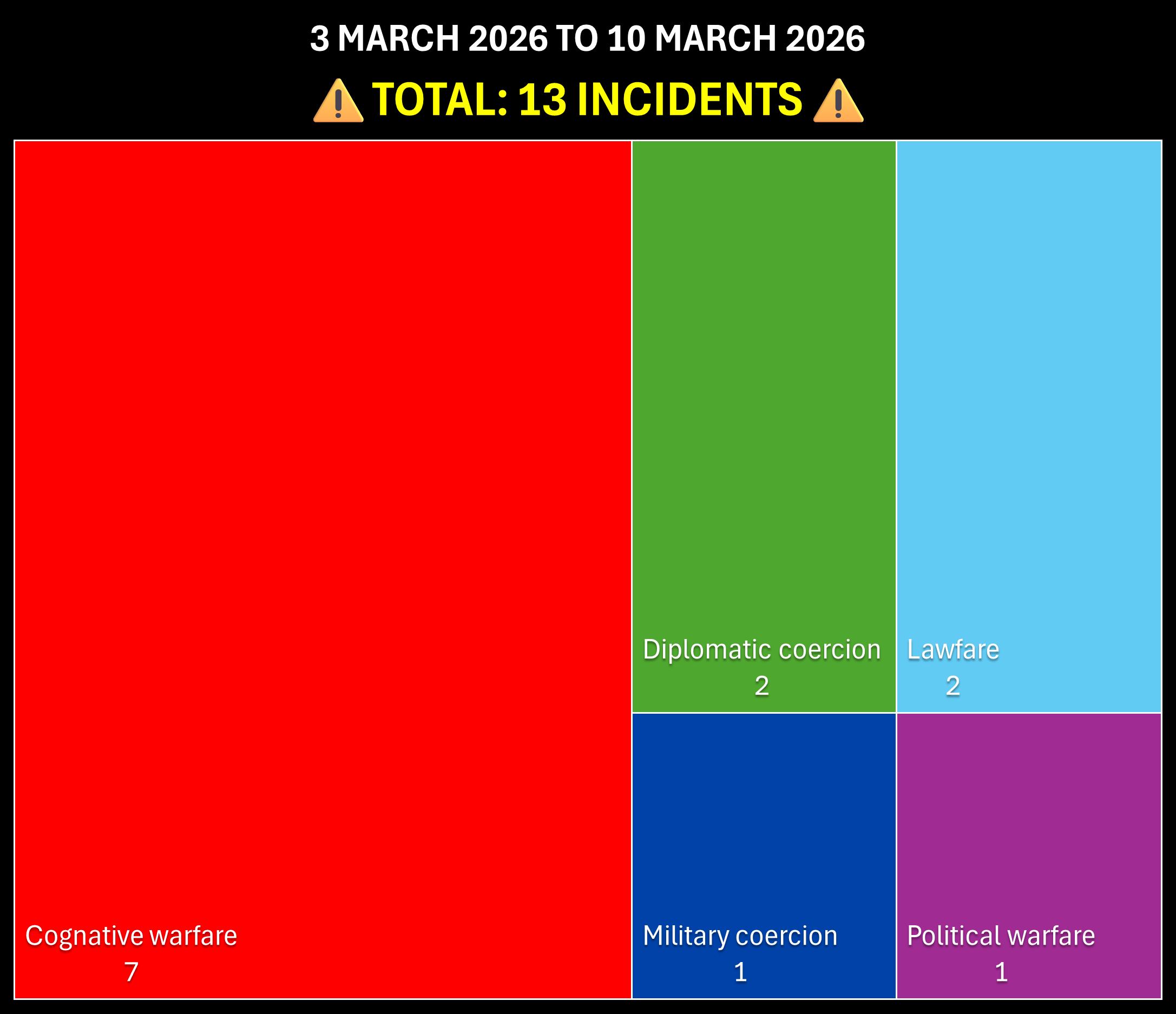
This edition covers the period: 3 March 2026 to 10 March 2026.
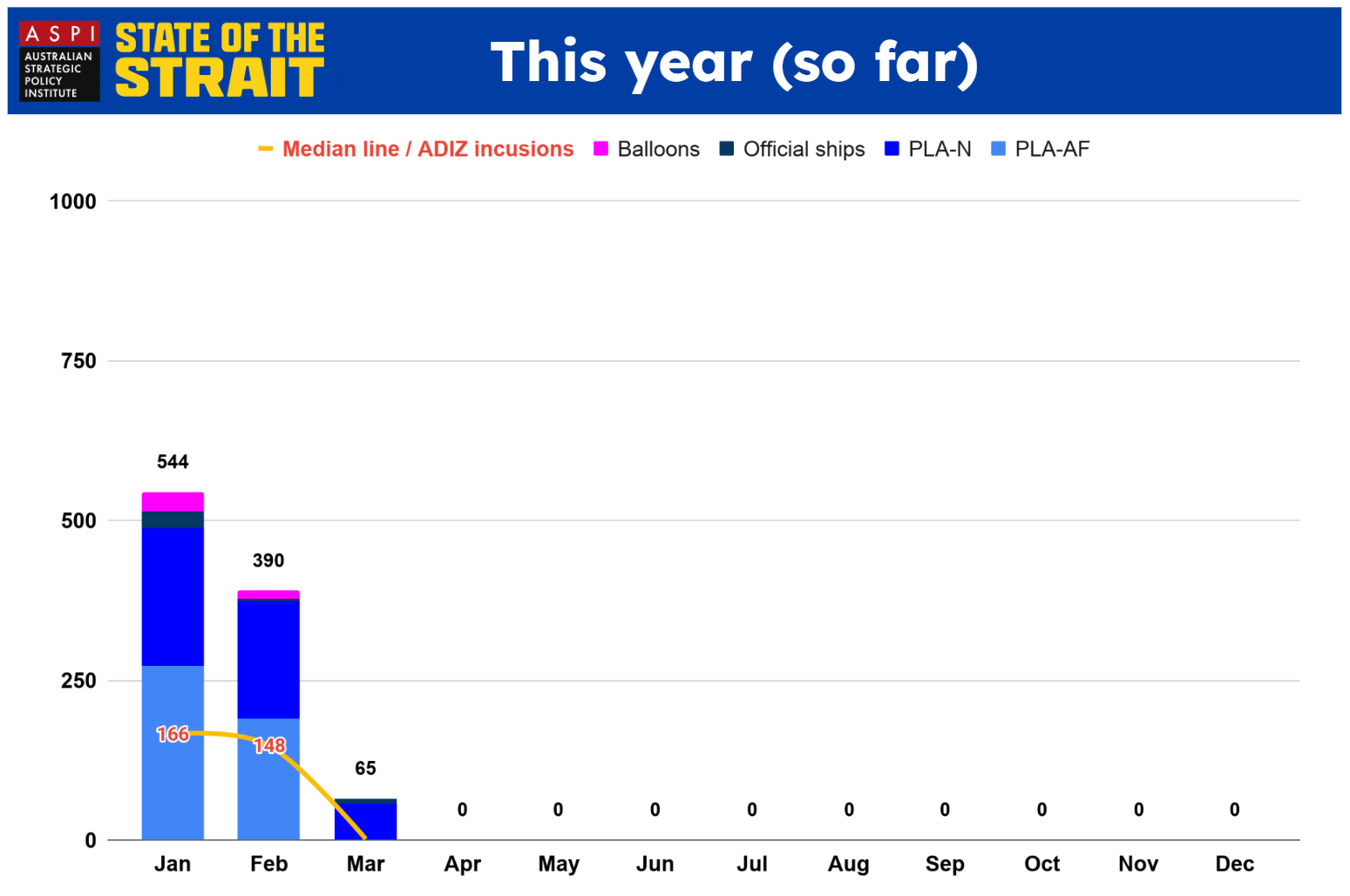
For nine of the past ten days, Taiwan has reported no People’s Liberation Army (PLA) aircraft operating near the island. That absence is unusual and has sparked speculation about possible causes, including a possible tactical pause ahead of the upcoming Trump–Xi meeting later this month or a temporary recalibration of operations for diplomatic optics.
But here at ASPI’s State of the Strait, we assess that given the sustained tempo of PLA activity around Taiwan in recent years, the more likely explanation lies in operational or logistical factors rather than a shift in Beijing’s underlying strategy.
Since roughly 2020, near-daily PLA air activity around Taiwan has become a defining feature of Beijing’s military coercion. Fighter aircraft, bombers and surveillance platforms routinely operate near Taiwan’s Air Defence Identification Zone (ADIZ), forcing Taiwan to scramble aircraft and normalising China’s military presence in the strait.
Air incursions are generally considered more escalatory and operationally risky than a PLA Navy presence (which has continued during this period) because they involve contested airspace, higher accident risk and direct interception by Taiwan’s air force.
Against that backdrop, such a sustained pause is noticeable. While short fluctuations in activity are common, several consecutive days without aircraft is rare given the operational tempo established in recent years. It is too early to draw firm conclusions, but three explanations appear possible:
Most likely: Fuel conservation amid global energy uncertainty
The most likely explanation may lie in resource management rather than any Taiwan-specific development. The reduction in PLA flights coincides with rising instability in the Middle East following Israeli and American attacks on Iran, and subsequent Iranian retaliations – events that have introduced volatility into global energy markets.
Military aviation is extremely fuel intensive. Sustaining near-daily fighter patrols and bomber sorties over several years consumes significant quantities of aviation fuel. If Chinese leaders assess that global oil supplies could tighten, particularly as conflict disrupts shipping through key routes such as the Strait of Hormuz, it would be logical to conserve resources where possible.
Routine signalling flights near Taiwan may therefore be one of the easiest activities to temporarily scale back without significantly affecting operational readiness. From this perspective, the pause reflects caution rather than something more dramatic.
Plausible: Preparation for a major military exercise
A second possibility is that the lull reflects preparations for a larger military exercise. These exercises are not only political signalling. They also serve as operational preparation, allowing the PLA to rehearse complex joint operations and test command coordination across services.
Large joint drills require careful preparation. Aircraft may undergo maintenance cycles, units may reposition to forward bases, and operational planning must be synchronised with naval and rocket force components. In previous cases, major exercises around Taiwan have sometimes been preceded by several days of relatively low or even absent PLA aircraft activity as forces prepare.
Temporarily reducing routine sorties could therefore indicate that units are preparing for a more concentrated surge in activity. If this explanation proves correct, the current lull may represent a staging period before another spike in PLA air operations around Taiwan.
Least likely, but possible: Preparation for a quarantine or blockade-style escalation
A third possibility, less likely but strategically significant, is that the pause reflects preparations for a more serious escalation. In recent years, PLA exercises around Taiwan have increasingly rehearsed elements associated with maritime control operations, including encirclement drills, joint air–sea patrols and missile strike simulations.
If Beijing were considering a move to escalate its coercion strategy militarily, such as a limited quarantine or blockade-style operation, it might begin by adjusting routine operational patterns while repositioning forces across the theatre.
There is currently no clear evidence that such a shift is imminent, making this the least likely explanation. However, given the gradual escalation of Chinese military pressure around Taiwan over the past several years, it cannot be entirely ruled out.
Ultimately, the temporary absence of PLA aircraft should not be interpreted as a reduction in Beijing’s pressure on Taiwan. It is more likely a short-term anomaly within a broader pattern of sustained coercion. The more important question is not why the aircraft have disappeared, but what form the next phase of activity will take when they return.
31 March to 2 April: Xi-Trump Summit in Beijing, China
A White House official confirmed the trip on 20 February, just before the highest U.S. court dealt Trump a stinging defeat by striking down many of the tariffs he has used in a global trade war, including some against rival China.
Weekly Charts: PLA activities in the waters and airspace around Taiwan
Source for charts: Taiwan’s ministry of national defense monitors PLA-AF aircraft, PLA-N naval vessels and PRC official ships (e.g. coast guard) and high-altitude balloons operating in the waters and airspace around Taiwan. Numbers are recorded daily for the 24-hour period 0600 to 0600 Taiwan Standard Time (UTC+8).
No incidents to report this week.
United front work targeting Taiwan
ASPI Comment: United front work targeting Taiwan is orchestrated by a network of party-state organisations that aim to influence, cultivate, and co-opt key figures within Taiwanese civil society. The Taiwan Affairs Office in China has described united front work as “an important magic weapon for the Communist Party of China to unite people and gather strength”. The CCP claims the right to speak on Taiwan’s behalf and uses united front work to claim legitimacy for annexation of Taiwan into the People’s Republic of China.
ASPI's State of the Strait tracks events that are facilitated by an agency within the united front and are intended to co-opt, exert malign influence, or redefine Taiwan, its people, and its history solely on CCP's terms.
Li Qiang discusses Hong Kong, Macau and Taiwan work in the Government Work Report [李强在政府工作报告中谈港澳台工作] Xinhua Li stated that China will thoroughly implement the Party’s overall strategy for resolving the Taiwan question in the new era, adhere to the One China principle and the “1992 Consensus,” resolutely crack down on “Taiwan independence” separatist forces, oppose interference by external forces, promote the peaceful development of cross-strait relations, and advance the cause of national reunification. China will deepen cross-strait exchanges and cooperation and integrated development, jointly inherit and promote Chinese culture, implement policies ensuring that Taiwan compatriots receive equal treatment, enhance the wellbeing of people on both sides of the Strait, and work together to advance the great cause of national rejuvenation.
Bellicose language about Taiwan
China vows resolute fight against “Taiwan independence” separatist forces Xinhua China has pledged to resolutely fight separatist forces aimed at “Taiwan independence” and oppose external interference, according to a government work report submitted to the annual session of the National People’s Congress, or the national legislature, which opened on 5 March. The report stressed the need to fully implement the Communist Party of China’s overall policy for the new era on resolving the Taiwan question, reaffirming commitment to the one-China principle and the 1992 Consensus. China has vowed to promote the peaceful development of cross-Strait relations and advance the cause of national reunification, according to the report.
Falsely portraying Taiwan as the aggressor or obstacle to peace
MOFA rejects China’s Taiwan claims Taipei Times Minister of Foreign Affairs Lin Chia-lung 8 March rejected Chinese Minister of Foreign Affairs Wang Yi’s comments about Taiwan, criticizing China as a “troublemaker” in the international community and a disruptor of cross-strait peace. Speaking at a news conference on the sidelines of the Chinese National People’s Congress, Wang said that Taiwan has always been a territory of China and that it would be impossible for it to become its own country. The “return” of Taiwan to China was the natural outcome of the Chinese people’s resistance against Japan in World War II, and that any pursuit of independence was “doomed to fail,” he said, claiming that the Cairo Declaration, Potsdam Declaration, Japanese Instrument of Surrender and UN General Assembly Resolution 2758 determined Taiwan’s status.
Pressuring others to refer to Taiwan incorrectly as a part of China
South Korean travel system still using ‘China (Taiwan)’ Taipei Times Taiwanese travelers to South Korea can choose to fill out a paper arrival card instead of using the country’s electronic system, which still uses the name “China (Taiwan),” despite Taipei having requested a correction, the Ministry of Foreign Affairs said yesterday. South Korea in February last year launched its e-Arrival Card system, an online entry declaration form for people to complete within three days prior to their entry into the country, which is meant to replace paper arrival cards. However, many Taiwanese have filed complaints to the ministry, saying that the online system lists Taiwan as “China (Taiwan)” in dropdown menus for “place of departure” and “next destination.”
Disinformation campaigns designed to undermine Taiwan
Taiwan never was and never will be a country, says China’s Wang Yi CNA China’s Foreign Minister Wang Yi said the future of Beijing’s ties with Japan depends on Tokyo’s choices. Relations have been frosty since Japanese Prime Minister Sanae Takaichi’s remarks on Taiwan last year. She had suggested that Japan may deploy its military if China attacked the self-ruled island, as that would be a “survival-threatening situation” for Tokyo. Mr Wang also criticised Taiwan’s ruling Democratic Progressive Party’s pro-independence rhetoric as the root cause of instability in the strait. He warned that Taiwan never was and will never be a country.
What’s the one big thing missing from Beijing’s Taiwan deterrence strategy? South China Morning Post Beijing has built military capacity and strengthened political resolve but needs to project a more credible deterrence as it steps up unification with Taiwan over the next five years, according to a mainland Chinese policy adviser. Li Yihu, dean of the Taiwan Research Institute at Peking University, said the reunification process would enter an “accelerated phase” in the next five years and the mainland needed to do more to communicate an understanding of what he said was the inevitability of the process. “Currently, we are doing very well in terms of building the capacity and the resolve to use [military deterrence], but we still need to work on ensuring that … both overt and potential adversaries fully understand the consequences of deterrence and the gains and losses,” he said.
Historical drama popular across Taiwan Strait shows shared aspiration for peace: spokesperson Xinhua A Chinese mainland spokesperson on 4 March responded to a media inquiry about the epic historical television series “Swords Into Plowshares,” which has attracted widespread viewership and discussion across the Taiwan Strait, at a regular press conference. The series, whose Chinese title literally translates as “Peaceful Years”, is set during the tumultuous Five Dynasties and Ten Kingdoms period (907-979). At the heart of the story is the King of Wuyue, whose peaceful surrender to the Song Dynasty (960-1279) was a pivotal act that helped reunify China at that time. The drama underscores the enduring conviction of the Chinese nation to oppose division and strive for unity, said Zhang Han, a spokesperson for the State Council Taiwan Affairs Office.
ASPI Comment: The historical drama highlighted in the article is set during the ‘Five Dynasties and Ten Kingdoms’ period during a time when Taiwan was inhabited largely by indigenous societies and outside Chinese imperial administration. The Taiwan element therefore comes not from the story itself but from its official interpretation by Beijing, which frames the drama as illustrating the virtues of unity and peaceful reunification. By promoting a mainland historical episode as politically meaningful “across the Strait,” Chinese authorities are using the drama as propaganda to imply a shared historical narrative between China and Taiwan, reinforcing the claim that reunification is historically natural and desirable.
Amplifying criticism of Taiwan or the Lai administration
We hope Taiwan compatriots to clearly understand ‘Taiwan independence’ is a dead end: NPC deputy from Taiwan delegation Global Times “We hope that the vast number of Taiwan compatriots clearly understand that ‘Taiwan independence’ is a dead end, external forces are unreliable, the process of reunification is unstoppable, and the Democratic Progressive Party (DPP) authorities’ attempt to seek independence by relying on external forces is doomed to fail,” said Zeng Liqun, a deputy from the Taiwan delegation to the 14th National People’s Congress and executive director of the national federation of Taiwan compatriots, in an interview with the Global Times on 4 March during the national “two sessions” - the annual meetings of China’s top legislature and top political advisory body.
Japan says no contact with Taiwan PM during visit CNA Japan said on 9 March that Taiwan’s Premier Cho Jung-tai had no contact with government officials during a weekend visit in which he watched a baseball game in Tokyo. Cho’s trip was the first by a sitting Taiwanese premier since 1972, except for a typhoon-enforced stopover by Yu Shyi-kun in 2004, Japan’s foreign ministry told AFP … “The trip was self-funded and it was a private activity. The only arrangement was to cheer for Team Taiwan together with our fellow citizens. There was no other purpose, so there are no further comments,” Cho said.
Wang Yi warns Japan on Taiwan ‘red line’, dashing hopes of ending diplomatic row South China Morning Post Beijing’s top diplomat has issued a stark warning against any attempt to thwart reunification with Taiwan and repeated his country’s criticism of Tokyo, dimming hopes that the diplomatic row sparked by Japanese Prime Minister Sanae Takaichi’s comments on Taiwan would come to an end any time soon. The comments by Foreign Minister Wang Yi, delivered in a press conference on Sunday as part of the “two sessions”, were the latest in a series of strong criticisms by Beijing officials following Takaichi’s remarks in November, when she suggested Japan’s military might intervene in the event of a Taiwan conflict.
Taiwan Affairs Office probe of Liu Shyh-fang nephew harms ties: MAC Taipei Times A vow by China’s Taiwan Affairs Office (TAO) to investigate Minister of the Interior Liu Shyh-fang’s nephew is a case of transnational repression and is detrimental to cross-strait interactions, Mainland Affairs Council (MAC) Minister Chiu Chui-cheng said in an interview published yesterday. On 27 February, Hong Kong newspaper Ta Kung Pao reported that Liu had received political donations from her nephew Yen Wen-chun. Yen holds executive positions at three firms in China, the Chinese state-owned publication said.
China severely punishes “Taiwan independence” separatists Xinhua China severely punished diehard separatists seeking “Taiwan independence” in 2025 in an effort to safeguard national security, the Supreme People’s Court said 9 March in its work report. The Anti-Secession Law has been effectively enforced in China, according to the report submitted to the ongoing national legislative session for deliberation.
ASPI Comment: For more on Beijing’s increased lawfare efforts against Taiwan in 2025, see ‘An army of lawyers is advancing. Taiwan is the target’ in The Strategisthere.
Thanks for reading! This post is public so feel free to share it.