Welcome to the latest edition of ASPI’s ‘State of the Strait’ Digest.
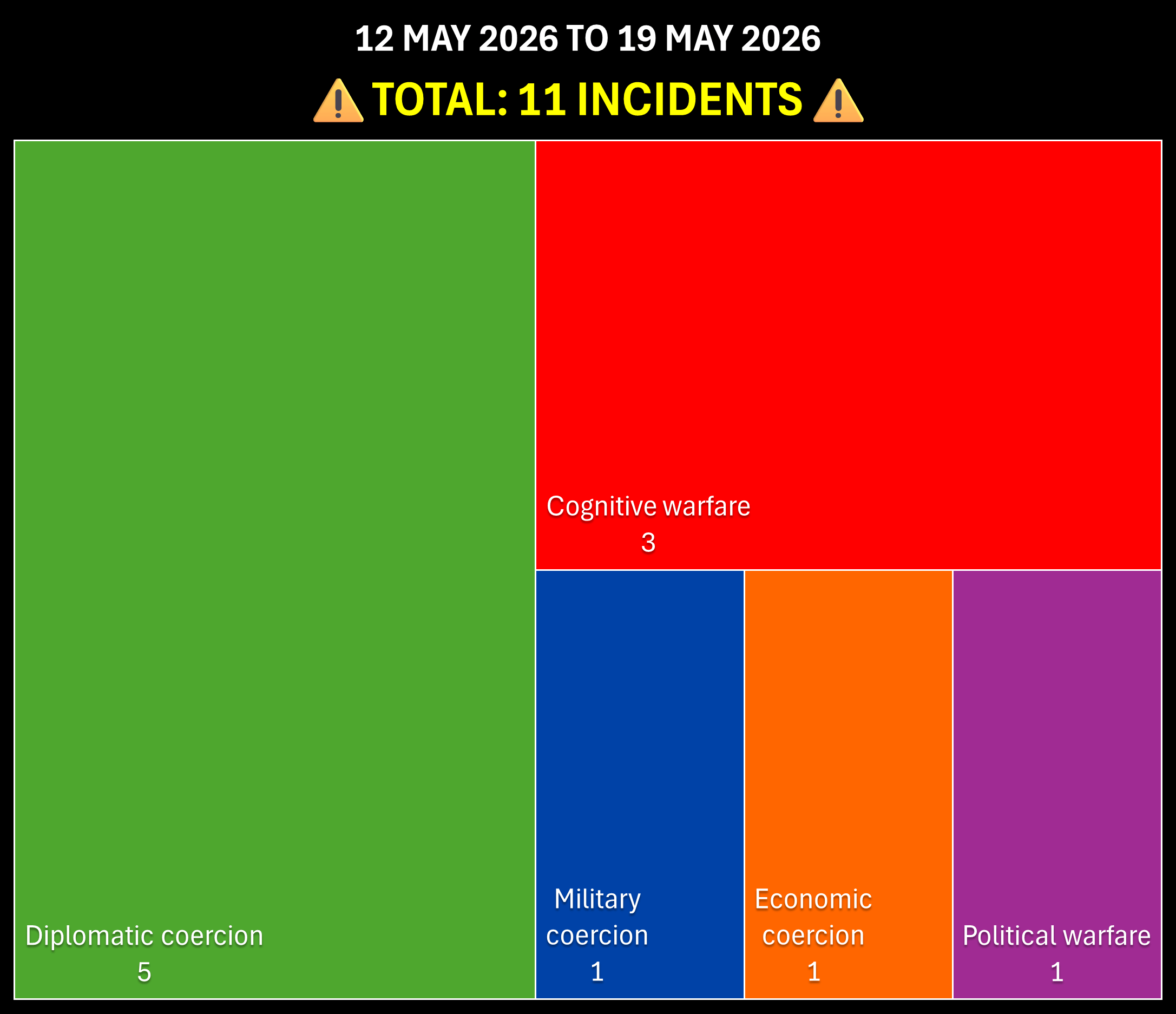
Each week ASPI tracks Beijing’s pressure campaign against Taiwan, including military, economic, and diplomatic coercion, as well as political, cognitive, cyber, and legal warfare.
This edition covers the period: 12 May 2026 to 19 May 2026.
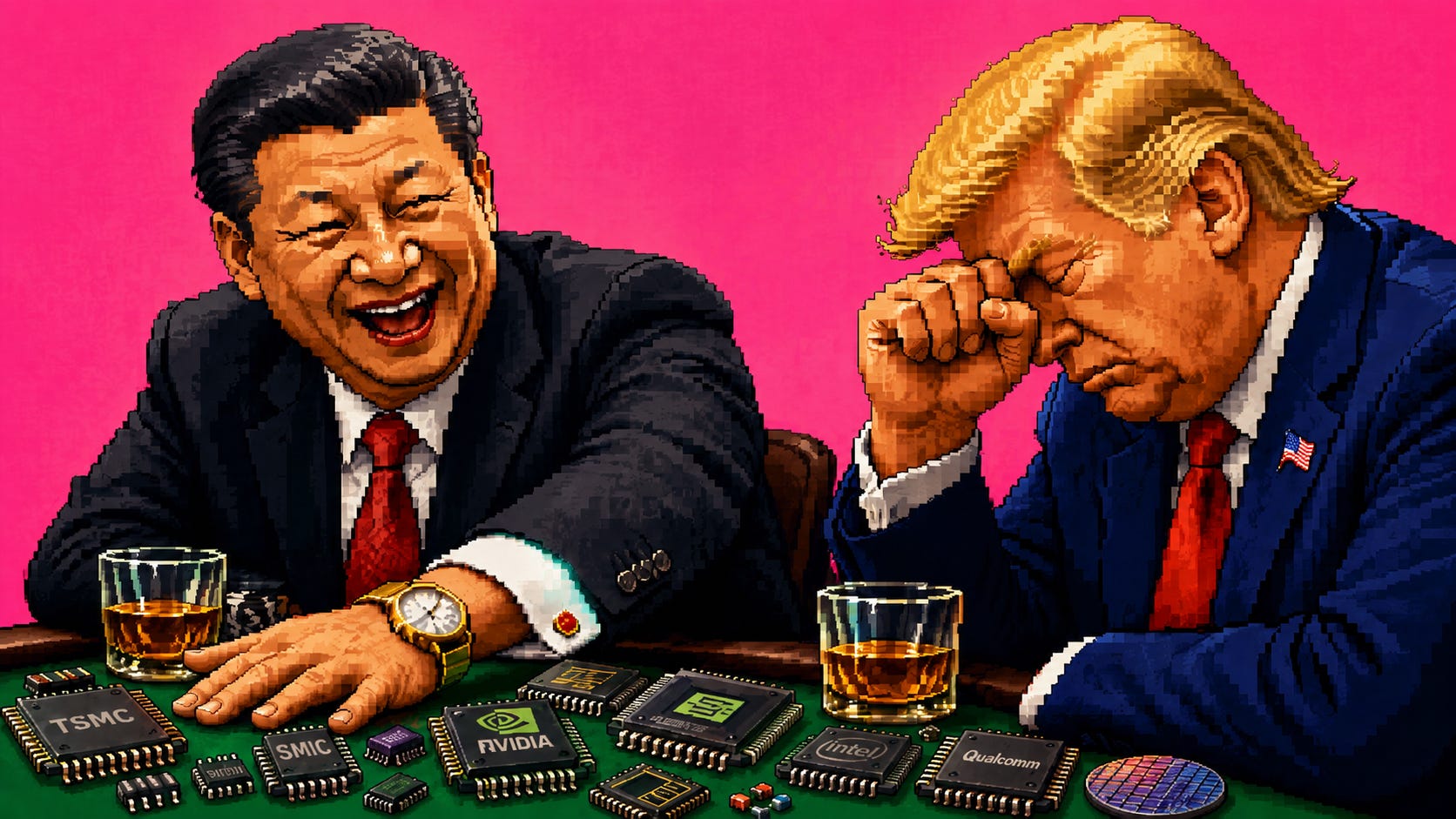
Beijing’s most important gain from the Trump–Xi summit may not be a concrete policy concession, but the perception that one is already underway. Xi did not need Trump to formally trade away support for Taiwan. He only needed Trump to sound like he might.
That is the narrative Beijing wants: that Trump is preparing to sell out Taiwan as part of a broader accommodation with China. Xi would no doubt welcome an actual deal that weakens US support for Taiwan. But Beijing does not need the deal itself to extract value from the summit. It needs the story of the deal. Trump’s instincts for dealmaking, public boasting, ambiguity and transactional leverage gave Beijing exactly that: a US president whose own words made Taiwan look negotiable.
Trump’s post-summit comments gave Beijing useful material. Asked about Taiwan arms sales, Trump said: “I’ll be making decisions,” before adding that “the last thing we need right now is a war that’s 9,500 miles away.” That is ill-disciplined because it links the routine provision of defensive weapons to Taiwan with the risk of war. It implicitly accepts Beijing’s framing that US support for Taiwan is what produces danger, rather than China’s coercion and threats to use military force.
Trump also said Xi raised Taiwan independence and that he simply “heard him out” and “didn’t make a comment.” That is a problem because silence can be read as acquiescence. Beijing’s preferred language casts “Taiwan independence” as the central threat to peace, and Trump let that framing sit unchallenged. But Taiwan is not a province waiting to secede. It is an independent, democratic state under the name ‘Republic of China’, with its own government, military, borders, currency and elections. The real danger is not Taiwan suddenly “declaring independence” from China; it is Beijing using that hypothetical as a pretext to justify coercion.
That distinction matters because some of the post-summit media coverage then picked up Beijing’s framing, treating a Taiwanese “declaration of independence” as the provocative act to watch. But that framing starts from the wrong premise. It makes Taiwan’s existence look like the source of instability, rather than China’s threat to use force against a society it does not control. Washington’s better framing should be that the core issue is any forced change to the status quo. By failing to say that clearly, Trump allowed Xi’s terms of debate to stand.
The most damaging line was on the ‘Six Assurances’. Asked about the Reagan-era assurance that the US would not consult Beijing on Taiwan arms sales, Trump said: “I think 1982 is a long way away.” He then defended discussing arms sales with Xi. This weakens one of the core political guardrails in US Taiwan policy. Even if Trump did not make a commitment to Xi, the optics suggest Beijing has earned a consultative role in US decisions about Taiwan’s defence.
His comments to Fox News were worse. Trump said he had not approved the weapons package, that he “may do it” or “not do it”, and that “it depends on China” because it is “a very good negotiating chip for us.” That is exactly the narrative Beijing wants: Taiwan’s security being treated as a bargaining chip in a broader US–China negotiation. It tells Taipei that its defence may depend less on its own needs than on what Trump thinks he can extract from Xi.
Trump’s credibility problem compounds this. Because he routinely exaggerates and blurs fact with performance, even reassurance becomes unstable. When he says he made no commitment, allies may still wonder what was implied. When he says Xi does not want war, Beijing can pocket the compliment while continuing coercive pressure on Taiwan. When he says Taiwan is a “negotiating chip”, China does not need to prove the US is selling out Taiwan. It only needs Taiwanese voters to fear that it might.
Xi has his eye on Taiwan’s January 2028 presidential election. His goal is to erode Taiwanese confidence in the United States and encourage the election of a more Beijing-friendly leader. He is also preparing the language for a future crisis: if China creates one, Beijing will frame it as a reasonable response to American provocation.
Xi is still deterrable. But the goal must be to deter a crisis, not just a war. That requires resolve, restraint and disciplined language. Trump gave Beijing the opposite: ambiguity that sounded transactional, silence that sounded permissive, and rhetoric that made Taiwan look less like a partner than a bargaining chip to be haggled over.
19 May: Legislative Yuan to vote on President Lai impeachment
Taiwan’s opposition parties are set to force an impeachment vote against President Lai Ching-te over claims he rejected legislative oversight, but the motion is expected to fail because they lack the required two-thirds majority.
June: KMT Chair Cheng Li-wun visit to US
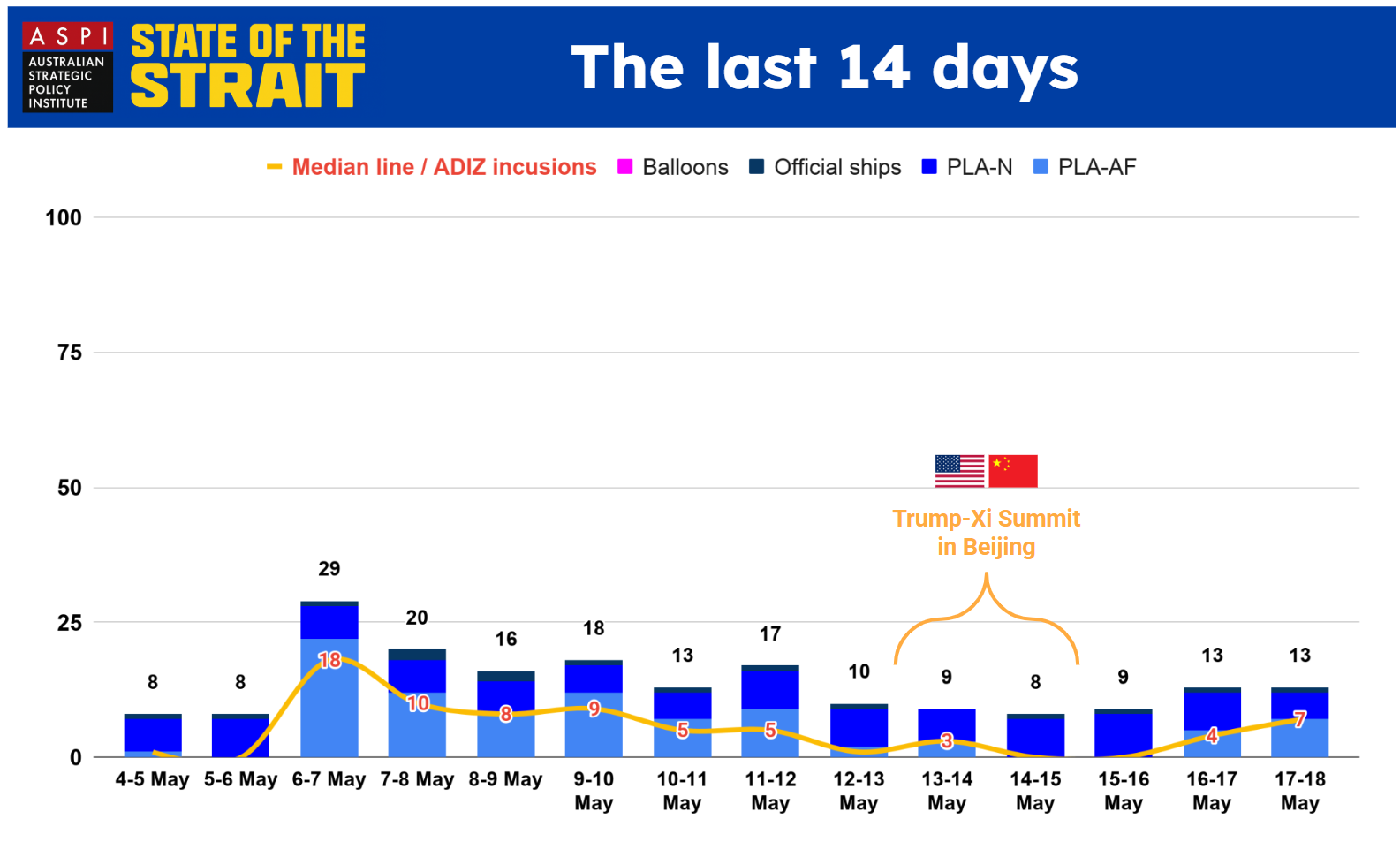
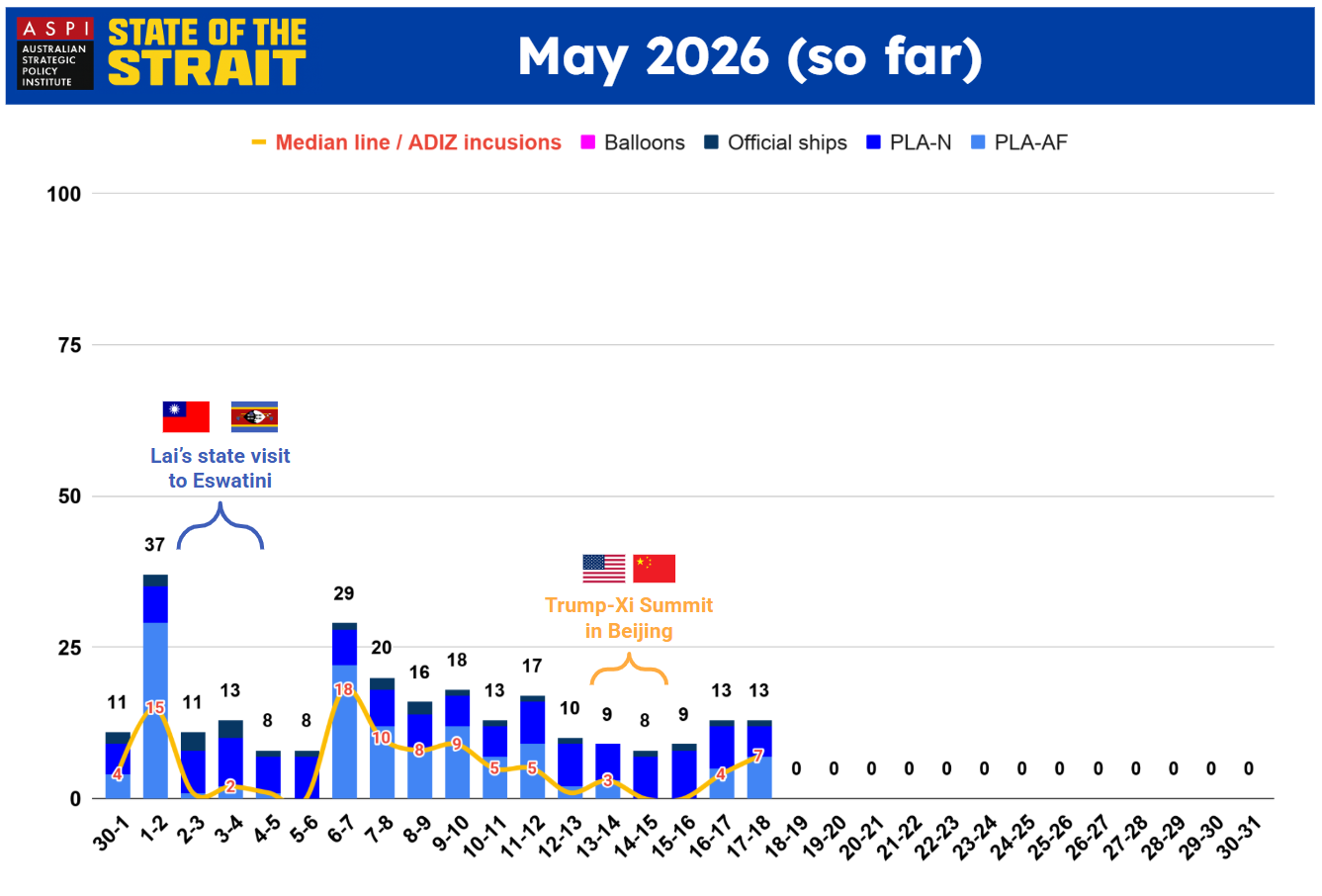
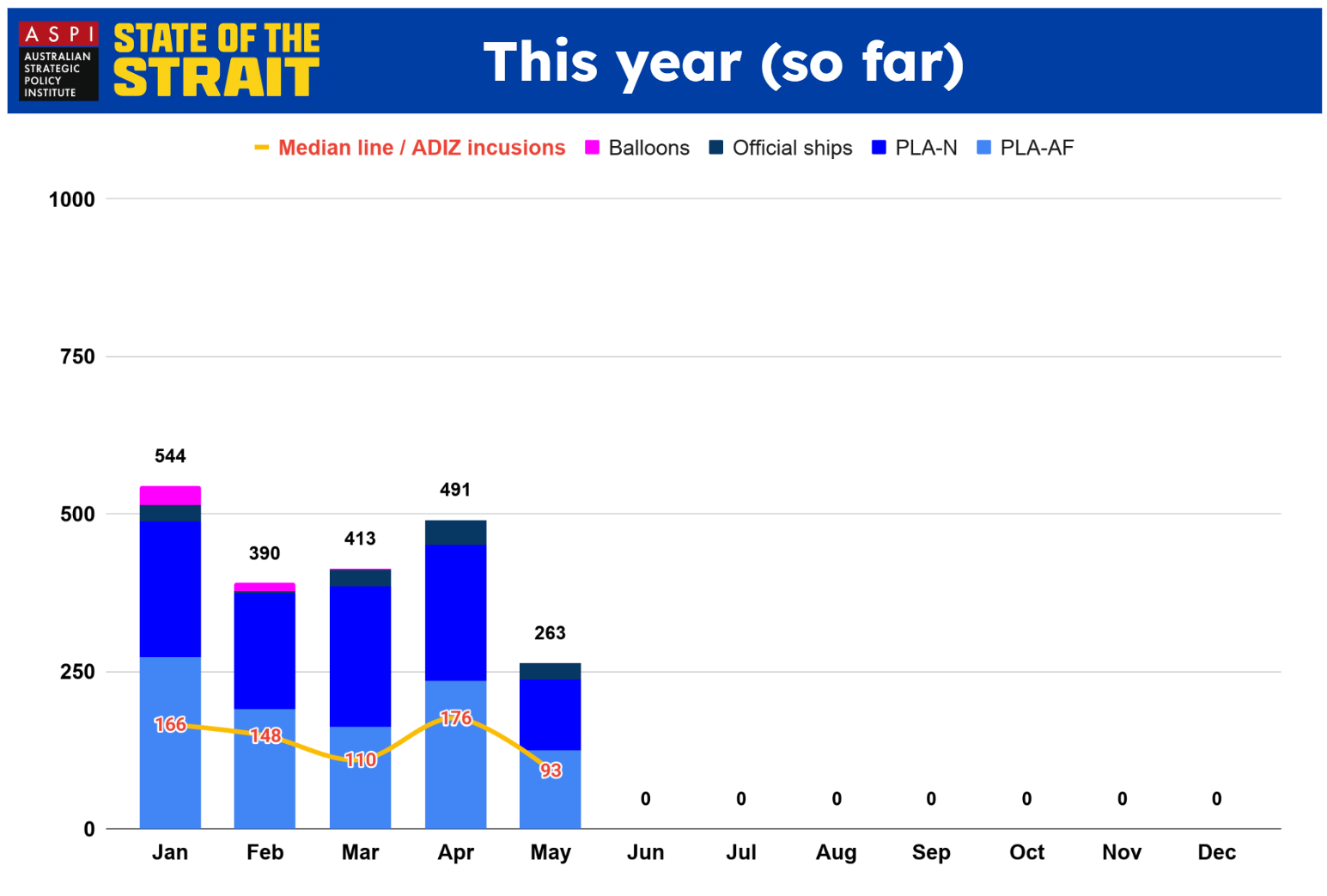
Weekly Charts: PLA activities in the waters and airspace around Taiwan
Source for charts: Taiwan’s ministry of national defense monitors PLA-AF aircraft, PLA-N naval vessels and PRC official ships (e.g. coast guard) and high-altitude balloons operating in the waters and airspace around Taiwan. Numbers are recorded daily for the 24-hour period 0600 to 0600 Taiwan Standard Time (UTC+8).
Imposing (and removing) restrictions on Taiwanese imports
TAO again raises Taiwan travel; MAC reiterates need for “mini-two associations” tourism talks [國台辦再提赴台旅遊 陸委會重申觀光小兩會協商] Central News Agency (Taiwan) China’s Taiwan Affairs Office said it had previously announced plans to promote the resumption of individual tourism to Taiwan by residents of Shanghai and Fujian, and hoped Taiwan would open up as soon as possible. Taiwan’s Mainland Affairs Council reiterated that negotiations must first take place through the tourism “mini-two associations”, and said it hoped the other side would respond to this request.
United front work targeting Taiwan
ASPI Comment: United front work targeting Taiwan is orchestrated by a network of party-state organisations that aim to influence, cultivate, and co-opt key figures within Taiwanese civil society. The Taiwan Affairs Office in China has described united front work as “an important magic weapon for the Communist Party of China to unite people and gather strength”. The CCP claims the right to speak on Taiwan’s behalf and uses united front work to claim legitimacy for annexation of Taiwan into the People’s Republic of China.
ASPI's State of the Strait tracks events that are facilitated by an agency within the united front and are intended to co-opt, exert malign influence, or redefine Taiwan, its people, and its history solely on CCP's terms.
Tonga-China Friendship Association condemns Taiwan authorities for disrupting Pacific Islands Forum Leaders Meeting [汤中友协谴责台湾当局破坏太平洋岛国论坛领导人会议] Xinhua Reporters learned on 17 May that the Tonga-China Friendship Association had issued a statement condemning what it called attempts by the Taiwan authorities to disrupt the Pacific Islands Forum Leaders Meeting. The association recently said in a statement that Taiwan’s authorities had used all means to try to disrupt the Pacific Islands Forum Leaders Meeting, while repeatedly attempting to expand their so-called “international space” and pursue “Taiwan independence” separatist activities. The Tonga-China Friendship Association said it firmly opposed this.
Disinformation campaigns designed to undermine Taiwan
Trump warns Taiwan not to declare independence DW US President Donald Trump issued a stark warning to Taiwan following his recent visit to China, cautioning against any move toward formal independence and reigniting tensions over one of the world’s most sensitive geopolitical flashpoints. Trump’s comments triggered concern and uncertainty in Taiwan, where officials stressed that the island is already a sovereign entity under its official name, the Republic of China.
ASPI Comment: For more on why Taiwan cannot declare independence, even if it wanted to, see ‘Every day is Independence Day in Taiwan’ in The Strategisthere.
Gov’t says Taiwan a full APEC member, blasts TAO’s ‘one-China’ remark Focus Taiwan Taiwan’s Ministry of Foreign Affairs (MOFA) on Wednesday said the country has been a full member of the Asia-Pacific Economic Cooperation (APEC) for decades, blasting China’s earlier statement that Taipei’s participation in the forum is conducted under the so-called “one-China principle.” Zhang Han, spokesperson for China’s Taiwan Affairs Office (TAO), said at a regular news briefing earlier 13 May that China, as the host of APEC in 2026, will handle Taiwan’s participation in APEC meetings in accordance with the “one-China principle” and related APEC memorandums of understanding (MOUs) and practices.
Amplifying criticism of Taiwan or the Lai administration
Trump warning against ‘Taiwan independence’ sends shockwaves in island; remarks deal a severe blow to DPP and Lai Ching-te: KMT vice chairman Global Times US President Donald Trump’s warning against “Taiwan independence” has sent shockwaves through Taiwan’s media and political circles. While pro-Democratic Progressive Party (DPP) outlets have largely attempted to downplay the remarks, a vice chairman of the Kuomintang characterized the speech as a severe blow to the DPP and Lai Ching-te. For analysts, the US president’s remarks underscore a highly pragmatic US approach. They note that Washington appears unwilling to allow a fringe group of separatist forces to derail vital US interests tied to the stability of China-US relations.
No incidents to report this week.
Outreach to Taiwan’s last 12 diplomatic allies
MOFA strongly refutes false and malicious claims by China’s Foreign Ministry regarding Taiwan’s sovereignty and Paraguayan President Peña Ministry of Foreign Affairs of the Republic of China (Taiwan) The Ministry of Foreign Affairs (MOFA) condemns in the strongest possible terms and solemnly refutes the malicious statements made by China’s Foreign Ministry at a press conference on 12 May. By falsely claiming that Taiwan was part of China and that Paraguayan President Santiago Peña was a pawn of “Taiwan independence separatist forces,” China’s Foreign Ministry attempted to undermine the close and long-standing diplomatic relations between Taiwan and Paraguay.
Challenging other countries’ One-China policies
China condemns Conservative MP’s Taiwan trip after ambassador’s warning Global News China’s embassy in Ottawa is criticizing a trip to Taiwan by Canadian MP Michael Chong, who said his visit is partly to “assert Canadian sovereignty” after China’s ambassador warned against future visits by parliamentarians. “Canada is a sovereign and independent country,” Chong said in a statement Sunday, the day he arrived in Taipei. “We do not take direction from a foreign government about where Canadian MPs can travel internationally, and where Canadian Navy warships can transit in international waters.” Chong was referencing a warning made by China’s ambassador to Canada, Wang Di, during an interview with The Globe and Mail last month.
Pressuring others to affirm Beijing’s One-China Principle
Pakistan Foreign Ministry: Pakistan has always firmly upheld the one-China principle [巴基斯坦外交部:始终坚定奉行一个中国原则] Xinhua Pakistan Foreign Ministry spokesperson Tahir Andrabi said on 14 May that Pakistan has always firmly upheld the one-China principle, and has maintained this principle in multilateral mechanisms such as the United Nations and the World Health Assembly. Speaking at a regular press conference that day, Andrabi said Pakistan’s position on the Taiwan issue is consistent: there is only one China in the world, and Taiwan is an inalienable part of China’s territory. Andrabi said Pakistan firmly supports China’s efforts to safeguard national reunification, as well as China’s relevant initiatives in different multilateral mechanisms, especially at the World Health Assembly.
Testing Taiwan’s security partners
Trump noncommittal to continued Taiwan arms sales after meeting with Xi POLITICO President Donald Trump said he was still deliberating a major arms sale to Taiwan, floating what would amount to a significant change in American foreign policy following a summit with Chinese President Xi Jinping in Beijing. “I’ll make a determination over the next fairly short period. I’m gonna make a determination,” he told reporters of the potential sale as Air Force One made its way back to the U.S. from China on Friday, saying he needed to speak to the person “that’s running Taiwan.”
Blocking Taiwan’s participation in international groupings
Taiwan condemns China over WHA participation ‘non-approval’ comments Focus Taiwan Taiwan has condemned China for saying that it had decided not to approve Taipei’s participation in the upcoming World Health Assembly because Beijing sees Taipei as part of its territory. Chang Chih-sha, deputy head of the Ministry of Foreign Affairs’ Department of International Organizations, reiterated the government’s stance on Tuesday that Taiwan, officially named the Republic of China, is an independent and sovereign nation. The People’s Republic of China has no right to represent Taiwan at the United Nations and its affiliated agencies, or other international organizations, Chang said during a weekly briefing.
No incidents to report this week.
Thanks for reading! This post is public so feel free to share it.