
Taiwan opens a new intelligence front against Beijing
Plus: Fake Facebook posts linked to Beijing’s interference in Taiwan’s elections


Welcome to the latest edition of ASPI’s ‘State of the Strait’ Digest.
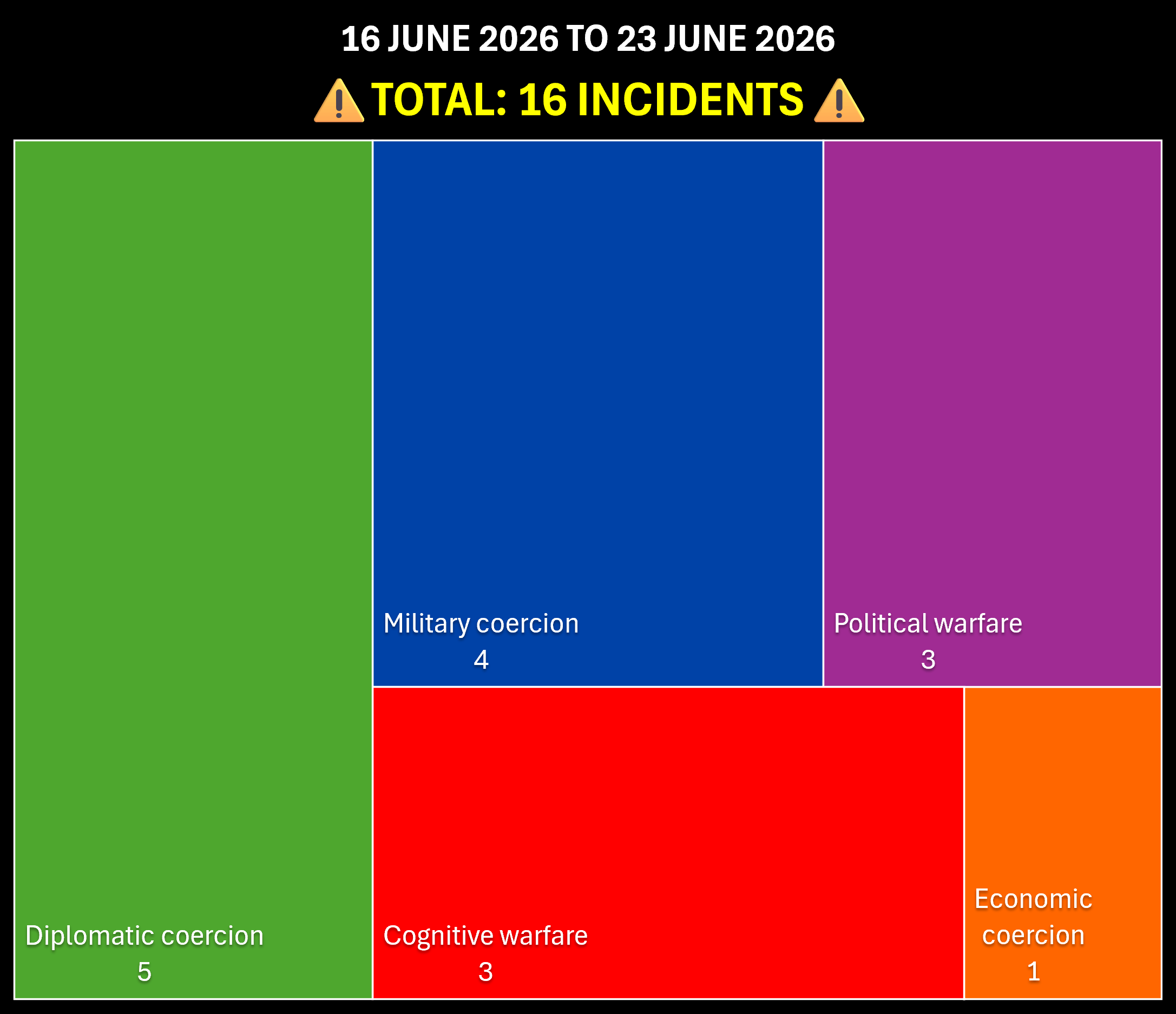
Each week ASPI tracks Beijing’s pressure campaign against Taiwan, including military, economic, and diplomatic coercion, as well as political, cognitive, cyber, and legal warfare.
This edition covers the period: 16 June 2026 to 23 June 2026.
Follow the Australian Strategic Policy Institute on X, on LinkedIn, and on Bluesky.


On 14 June, Taiwan’s chief intelligence agency launched an online portal inviting people in China to provide intelligence on Chinese political, military, economic and social developments. A website is not, by itself, a major offensive capability, but the initiative suggests Taiwan is seeking relatively low-risk ways to move beyond a primarily defensive posture and impose reciprocal costs on Beijing.
Taiwan’s National Security Bureau said it created the portal after receiving a growing number of approaches from people inside China offering information. The portal opened with a one-minute AI-generated promotional video depicting a Chinese civil servant watching colleagues disappear amid corruption investigations and political repression. Although the website is blocked inside China, it may still be accessible through circumvention tools such as VPNs.
Beijing responded on 17 June by accusing Taiwan of intelligence theft, infiltration and sabotage. The Taiwan Affairs Office promised “resolute countermeasures” and warned that Chinese citizens who supplied information could face criminal prosecution. It did not specify what those countermeasures would involve.
The portal’s immediate intelligence value is uncertain. Public tip lines can generate unreliable material, while Chinese counter-intelligence agencies will probably try to identify users, plant disinformation or compromise the system. Its significance therefore lies less in what it collects immediately than in what it signals about Taiwan’s changing posture.
For Beijing’s coercion campaign, the initiative weakens a longstanding asymmetry. China has traditionally been able to conduct espionage and political warfare against Taiwan while facing fewer comparable risks at home. It has sought to penetrate Taiwanese institutions, recruit military personnel and encourage reporting on alleged “Taiwan independence” activity. Taiwan is now mirroring one element of that approach by publicly soliciting information from inside China and signalling that coercion need not remain one-directional.
Taiwan once maintained more extensive human-intelligence networks inside China, including sources within the People’s Liberation Army. Chinese counter-intelligence operations dismantled several of these networks during the 2000s, making traditional human intelligence considerably riskier. Taiwan has nevertheless retained other means of collecting intelligence, including signals interception, technical collection, cyber capabilities and the cultivation of sources through digital and overseas channels. These methods cannot fully replace well-placed human assets, but they allow Taipei to collect against targets inside China without exposing as many officers or human networks to physical capture.
The portal reflects this evolution. Rather than attempting to rebuild vulnerable physical networks, Taiwan is using digital channels to identify leads and potential sources at lower cost and risk.
For Taiwan, the initiative may also reinforce resilience by showing that Taipei can adapt its intelligence methods and create limited reciprocal pressure despite Beijing’s much greater capabilities. The risk is escalation, particularly through greater Chinese cyberattacks, counter-intelligence operations and pressure against Taiwanese personnel. But the portal matters less as an immediate intelligence breakthrough than as evidence that Taipei is becoming more willing to contest Beijing’s initiative in domains where China has traditionally held the advantage.

22-26 June: Taiwan to stage five days of combat readiness drills


PLA reveals new weapons or military capabilities
China planning more surveys east of Taiwan as it expands maritime claims, state media report
The Independent
China will routinely carry out maritime surveys in the waters east of Taiwan in a bid to diversify claims to the international waters, the Chinese ministry of natural resources said, state media has reported. The surveys will be carried out by mainland China as it looks to expand its control over the waters through several methods, including military drills, coastguard patrols and natural resources surveys, reported a state broadcaster-affiliated social media account.
How China’s navy is tightening the noose on Taiwan
The Wall Street Journal
Late last month, Chinese navy ships, including large guided-missile destroyers, were positioned all around Taiwan … The ships tend to stay outside the 24-nautical-mile contiguous zone Taipei claims, but not always. They frequently break into so-called joint combat readiness patrols—periods of heightened activity when they push inward by a few miles in a choreographed tactic some security officials call “bumping the boundary.”
Testing Taiwan’s coastal defence capabilities
Coast Guard warns off Chinese vessel from Taiwan’s restricted waters
Focus Taiwan
Taiwan’s Coast Guard has warned off a Chinese oceanographic research vessel, the Xiang Yang Hong 22, from its restricted waters after initially warning it in its exclusive economic zone (EEZ), the Coast Guard Administration (CGA) said 19 June. At 11:35 p.m. Thursday, the vessel entered Taiwan’s restricted waters (which extend 12 to 24 nautical miles from Taiwan’s coast) off the coast of Su’ao in Yilan County, the CGA said … According to video footage released by the CGA, the crew of the Lanyu radioed Xiang Yang Hong 22 and said China has no sovereignty over waters off Taiwan’s east coast and demanded that the vessel depart immediately.
Weekly Charts: PLA activities in the waters and airspace around Taiwan
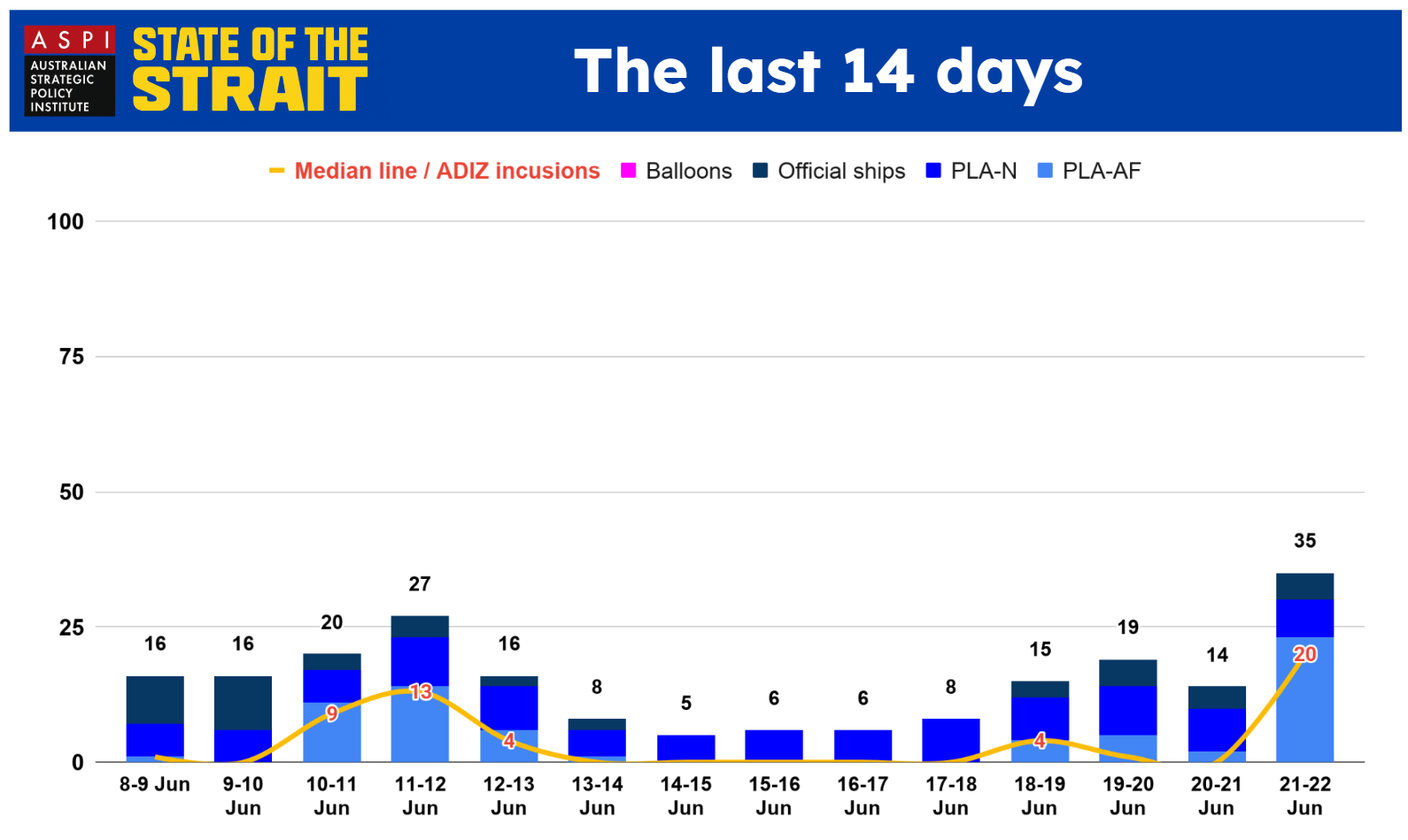
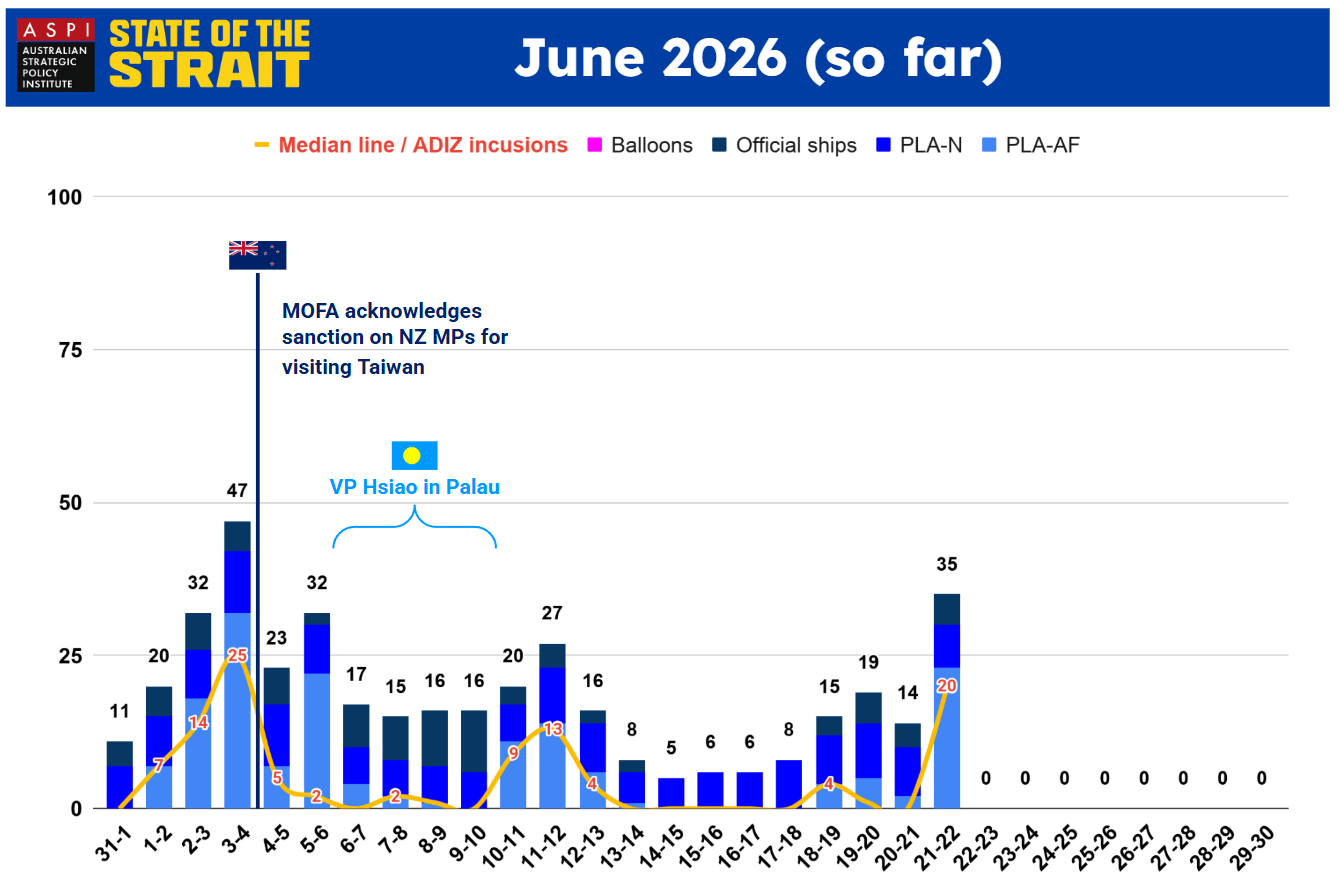
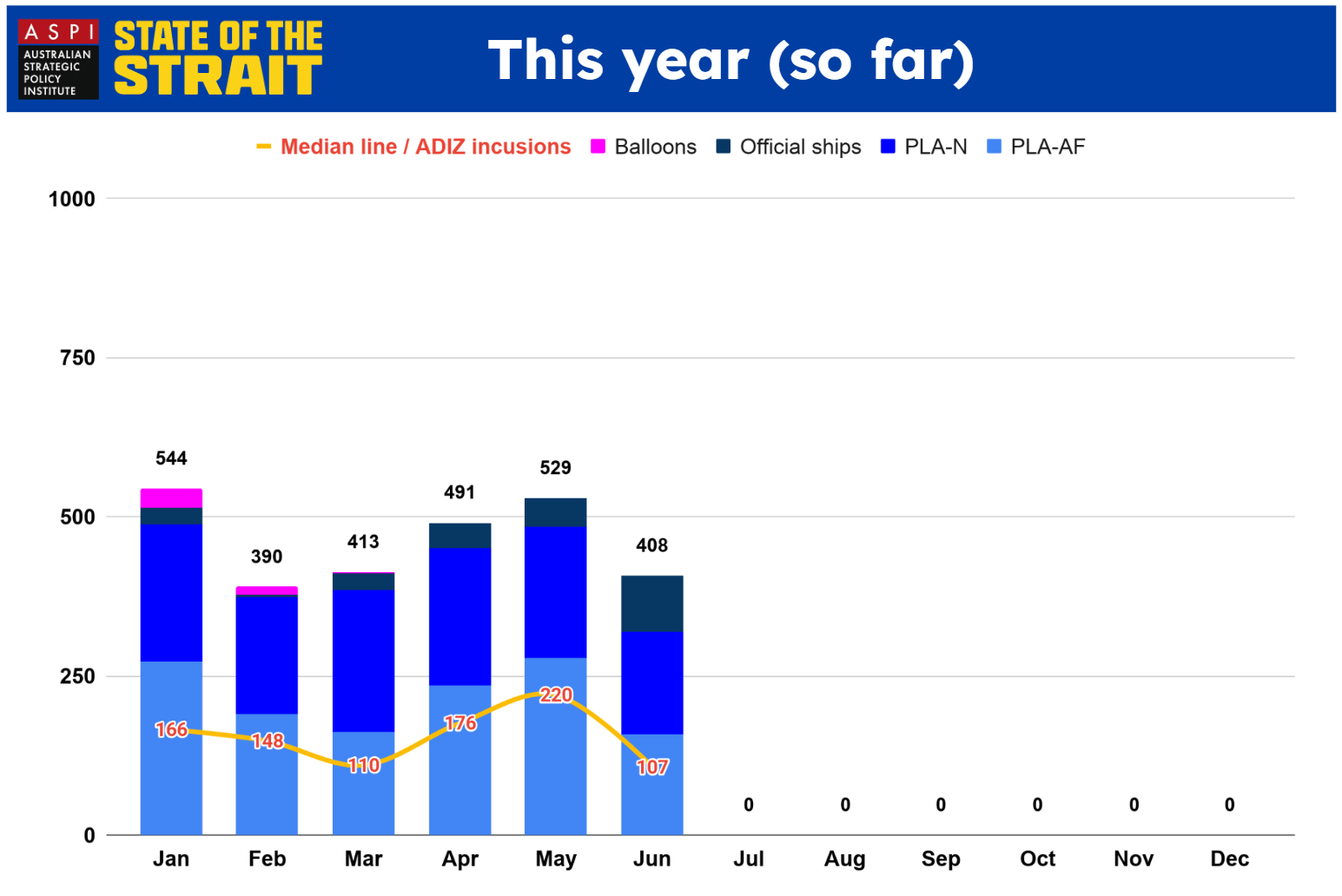
Source for charts: Taiwan’s ministry of national defense monitors PLA-AF aircraft, PLA-N naval vessels and PRC official ships (e.g. coast guard) and high-altitude balloons operating in the waters and airspace around Taiwan. Numbers are recorded daily for the 24-hour period 0600 to 0600 Taiwan Standard Time (UTC+8).

Imposing restrictions on Taiwanese imports
China atemoya plan stirs Taiwan trade dispute
Taipei Times
China’s offer to purchase more atemoya [a tropical hybrid fruit created by cross-pollinating the cherimoya and the sugar-apple] has reignited a cross-strait trade debate, with the government warning the move is a tactic to hook local farmers before cutting off market access. In a news release yesterday, the Ministry of Agriculture cited atemoya — a specialty of Taitung — as a prime example of China’s “raise, trap, kill” strategy, warning that it leaves local farmers exposed to severe market instability.

United front work targeting Taiwan
ASPI Comment: United front work targeting Taiwan is orchestrated by a network of party-state organisations that aim to influence, cultivate, and co-opt key figures within Taiwanese civil society. The Taiwan Affairs Office in China has described united front work as “an important magic weapon for the Communist Party of China to unite people and gather strength”. The CCP claims the right to speak on Taiwan’s behalf and uses united front work to claim legitimacy for annexation of Taiwan into the People’s Republic of China.
ASPI's State of the Strait tracks events that are facilitated by an agency within the united front and are intended to co-opt, exert malign influence, or redefine Taiwan, its people, and its history solely on CCP's terms.
Expert suggests creating united front tracker
Taipei Times
China has established a vast global network of organizations to expand its influence abroad, an Australian national security expert said, suggesting that Taiwan develop an international public database to track the network’s activities. The Chinese Communist Party’s (CCP) United Front Work Department mobilizes Chinese communities around the world through the China Council for the Promotion of Peaceful National Reunification, cultivating groups that promote “peaceful reunification,” Australian Strategic Policy Institute senior analyst Geoff Wade said.
CCP influence in Taiwan’s domestic politics
Official criticizes KMT for attending Fuxi memorial
Taipei Times
A government official yesterday criticized the Chinese Nationalist Party (KMT) for sending party officials to China to attend this year’s memorial for Fuxi, a religious event perceived as part of Beijing’s “united front” strategy against Taiwan. Traditionally depicted as a deity with a human head and a serpent’s body, the mythological figure is revered as the primordial ancestor of Chinese civilization. He was credited with inventing fishing nets, establishing formal marriage rituals and creating early written symbols. He also drew the Eight Trigrams, which laid the philosophical, metaphysical and cosmological foundation for the I Ching (“Book of Changes”). The memorial, jointly organized by China’s Taiwan Affairs Office, the Hong Kong and Macao Affairs Office of the State Council, and the Gansu Provincial Government, was held yesterday at the Fuxi Temple in Gansu Province’s Tianshui City.
Taiwan holds worship ceremony for mythical ancestor Fuxi. Xinhua
Taiwan content creator explores cultural roots at Fuxi Ceremony. China Daily
KMT accuses DPP of targeting Taiwan’s farmers over trade ties with mainland
South China Morning Post
Taiwan’s main opposition Kuomintang (KMT) has hit out at the island’s government for launching investigations into five agricultural groups over participation in a mainland forum. Taiwan’s Mainland Affairs Council (MAC) referred the five groups to the Ministry of Agriculture for investigation after they were accused of signing cooperation deals at the Straits Forum in southeastern Fujian province earlier this month. The move triggered a backlash from opposition politicians and farming groups, who argued that the Taiwanese government was penalising legitimate efforts to secure vital export markets.

Falsely portraying Taiwan as the aggressor or obstacle to peace
How a prize-winning Taiwanese novel could stoke Beijing’s worries over history
South China Morning Post
Taiwan’s first International Booker Prize-winning novel has reignited debate over the island’s shifting identity, with its portrayal of a distinctly Taiwanese historical experience at odds with narratives long promoted by Beijing. The attention surrounding Taiwan Travelogue comes at a sensitive time in cross-strait relations, as rival interpretations of Taiwan’s history increasingly shape public discussion over the island’s future and its relationship with mainland China. Set in Japanese-ruled Taiwan in 1938, the novel is framed as a fictional translation and follows a Japanese novelist and her Taiwanese interpreter on a culinary journey across the island.
Disinformation campaigns designed to undermine Taiwan
Expert flags China online poll scheme
Taipei Times
A cybersecurity expert has warned of a coordinated social media disinformation campaign, suspected to be a Chinese psychological warfare exercise designed to build networks for manipulating information and influencing this year’s local elections. Voting is scheduled for 28 November to elect mayors and city councilors in the special municipalities of Taipei, New Taipei City, Taoyuan, Taichung, Tainan and Kaohsiung, as well as county commissioners, mayors, councilors, and township mayors in the other 16 administrative regions. The expert, who spoke on condition of anonymity, raised an alert yesterday after discovering a flood of outdated news posts on Facebook on 15 June.
Flight attendant from Taiwan embraces opportunities on the mainland
Xinhua
A childhood dream took flight across the Strait. When Teng Yu Fei from China’s Taiwan region attended a Xiamen Airlines recruitment event in 2018, hearing the familiar Hokkien spoken during the interview instantly made her feel at home. Today, she is pursuing her dream in the skies while embracing new opportunities on the mainland.

No incidents to report this week.

Challenging other countries’ One-China policies
China views S.Korean official’s remarks on its unchanged position regarding Taiwan positively, hopes SK to abide by one-China principle: FM
Global Times
China views positively the remarks made by a South Korean official who reiterated, in its entirety and publicly to the press, the language on Taiwan in the China-ROK joint communiqué on the establishment of diplomatic relations, said a spokesperson for the Chinese Foreign Ministry on 20 June. Nam Jin, Director-General for Northeast Asian and Central Asian Affairs at the ROK’s Ministry of Foreign Affairs, told local reporters on Thursday that South Korea’s position regarding Taiwan as part of China has never changed.
Pressuring others to affirm Beijing’s One-China Principle
Is China turning up diplomatic pressure against Taiwan in Africa?
NewBloom
Recent events suggest that China is seeking to pressure Taiwan in Africa. Notably, Taiwanese delegates to the 11th Our Ocean Conference were denied entry to a side event, due to the organizers refusing to acknowledge their Taiwanese passports as valid travel documents. Subsequently, two delegates were detained for 20 hours by Kenyan authorities, during which their passports and cell phones were confiscated, even as the Taiwanese government was reportedly aware of the incident and sought to intervene.
Beijing’s bullying of Taiwan threatens ocean ecology. The Diplomat
Taiwan rejects China embassy in Belgium claim on Taiwan
Taiwan News
Taiwan’s representative office to the European Union and Belgium on 20 June rejected a claim by the Chinese Embassy in Belgium that Taiwan is part of China. The Chinese Embassy in Belgium posted on Facebook on Friday asserting Beijing’s position on Taiwan. The post also urged the Belgian public to support it. In response, Taiwan’s representative office issued statements in Mandarin, English, Dutch, French, and German. It said repeating a narrative does not make it a fact.
Lithuanian President says foreign minister’s tenure depends on China ties and ‘commitments’ to Taiwan region; remarks reveal an opportunistic mindset: Chinese expert
Global Times
In two consecutive days, Lithuanian President Gitanas Nauseda has remarked on ties with China. He said on 19 June the future of Foreign Minister Kestutis Budrys in his post will depend on progress in two areas: Normalizing relations with China and “delivering on commitments made to Taiwan,” Lithuanian media LRT reported. A Chinese scholar argued that despite Lithuania’s overtures for better bilateral ties, the remarks reveal an opportunistic mindset. By linking the foreign minister’s political fate to both China rapprochement and pledges to the Taiwan region, the statement lays bare a fence-sitting approach and a lack of sincerity in improving ties with China.
Taiwan rebukes China-Myanmar statement over sovereignty claims
Taiwan Times
The Ministry of Foreign Affairs on Friday condemned a China-Myanmar joint statement, saying it undermines Taiwan’s sovereignty and misinterprets UN General Assembly Resolution 2758. In a statement, the ministry said Myanmar and China issued the declaration on 17 June, which it said improperly downgraded Taiwan’s sovereign status, per CNA … It expressed regret that Myanmar’s government continues to align closely with China. Taiwan has provided cooperation in Myanmar since 2016 in areas including public health, economic development, and humanitarian assistance, it said.

No incidents to report this week.
For more on how tech, cyber and policy intersect across the region, check out ASPI’s Daily Cyber & Tech Digest.

Every fortnight, ASPI’s Fault Lines monitors actions that shape and contest the international order in Australia’s region.
