Welcome to the latest edition of ASPI’s ‘State of the Strait’ Weekly Digest.
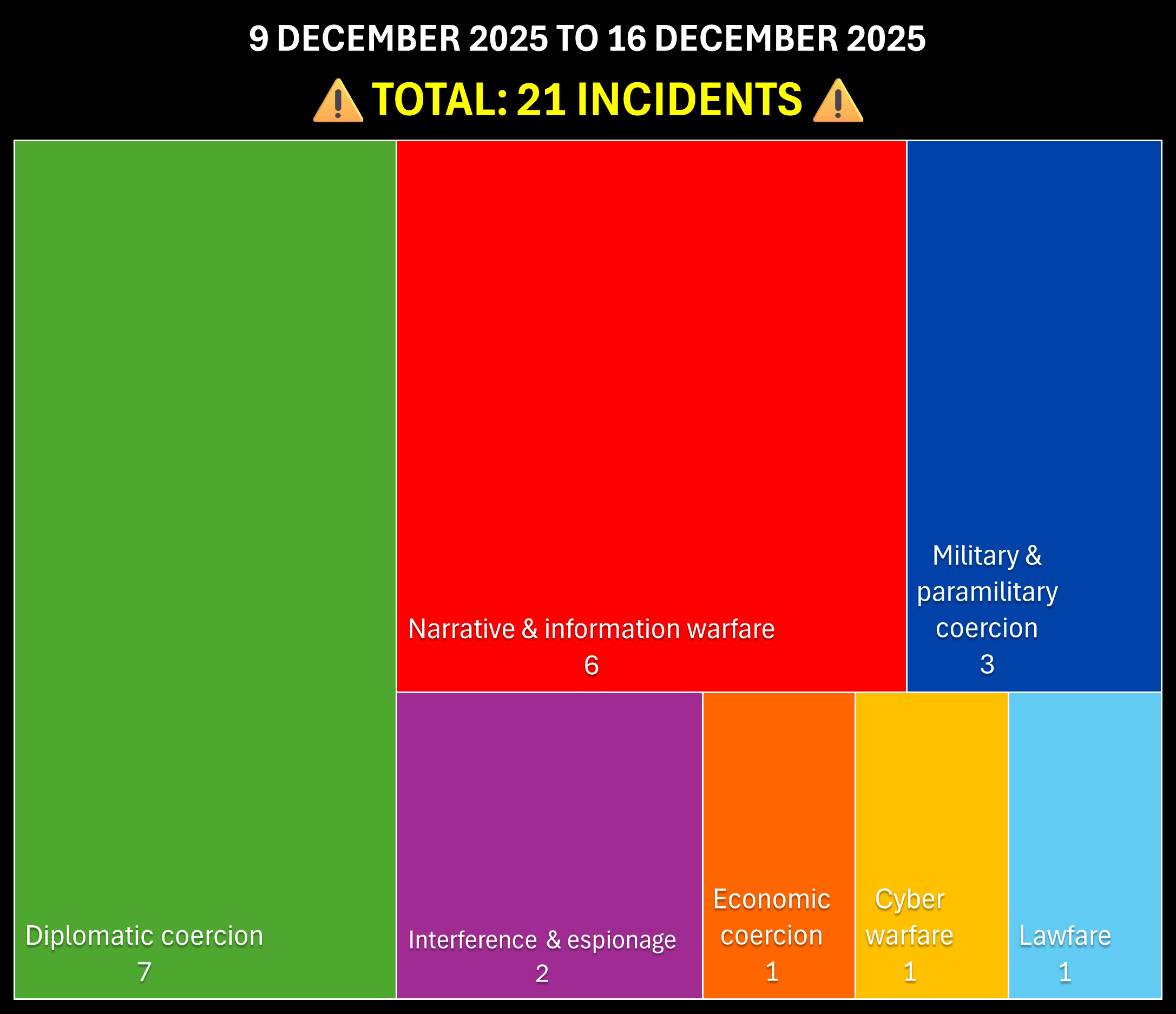
Each week ASPI tracks Beijing’s pressure campaign against Taiwan, including military, economic, and diplomatic coercion, as well as political, cognitive, cyber, and legal warfare.
This edition covers the period: 9 December 2025 to 16 December 2025.
Taiwan will end 2025 in a fundamentally more precarious position than where it started. The single biggest shift was Donald Trump’s return to the White House. His administration injected a degree of incoherence neither Taipei nor Beijing had anticipated: assertive pro-Taiwan language in official documents, but paired with a president whose public signalling towards both Taiwan and China was inconsistent and often absent at critical moments.
That gap is reshaping the behaviour of every other actor: Beijing is pushing harder, US allies are limiting their dependence on Washington’s leadership and keeping room for accommodation with Beijing, and Taiwan itself is treating heightened security measures as a permanent condition rather than a temporary response. The cumulative effect is a regional balance in which coercive pressure is normalised, deterrence is harder to sustain, and small missteps carry outsized risks.
Throughout 2025, the Trump administration showed a marked willingness to mute criticism of Beijing, soften punitive measures, and prioritise transactional concessions, particularly on trade, over maintaining deterrent clarity. The Japan–China diplomatic clash over Prime Minister Takaichi’s comments on Taiwan exposed how quickly Beijing would probe for weaknesses in the US–Japan alliance when Washington’s resolve looked uncertain. It also highlighted a new escalatory pathway: a Taiwan crisis triggered not by Taipei’s actions but by Sino-Japanese friction beyond Taiwan’s direct control.
At the same time, the PLA moved from episodic signalling to a more continuous coercive operating pattern. Air and naval incursions remained high throughout the year, joint exercises increasingly resembled encirclement and blockade rehearsals, and amphibious units experimented with mobilising civilian vessels. These trends compressed Taiwan’s warning time, hardened the military “new normal,” and made day-to-day crisis risk materially higher than at the start of the year.
Beijing also intensified efforts to constrict Taiwan’s international space. Pacific partners restricted Taiwan’s participation in regional forums under Chinese pressure, while governments in Southeast Asia and Europe became more cautious about deepening ties with Taipei (despite great efforts by Taiwan to engage with that continent). The effect was to narrow Taiwan’s operational diplomatic room.
Beijing also shifted its political and legal framing of unificationthis year. China’s state media messaging recast the year as the eightieth anniversary of Taiwan’s “return” to China after World War II, embedding unification in a narrative of restoring historical order. This reframing was designed to normalise unification as an accomplished historical fact and narrow the space for international contestation by presenting Taiwan’s future as already settled.
More importantly, Fujian Province’s new Regulations on Promoting Cross-Strait Common Standards (to take effect on 1 January 2026) codified mechanisms for aligning product standards, professional qualifications, and public services between Fujian and Taiwanese residents. On their face, these measures only affect Taiwanese living in the mainland. But strategically, they strengthen Beijing’s argument that “institutional convergence” is already underway and create administrative precedents that future CCP rhetoric will use to erode the legitimacy of the status quo.
Internally, Taiwan absorbed the consequences of this more threatening regional climate. The Lai administration strengthened counter-espionage enforcement, broadened cognitive-warfare monitoring, and tightened its immigration and visa arrangements for Chinese nationals. These measures respond to escalating activity from Beijing, yet they also deepened Taiwan’s shift into a more permanent national-security posture.
As Taiwan moves into 2026, will these pressures harden into a new strategic equilibrium or do further shocks await? Much will depend on whether Washington can restore deterrent clarity, whether Japan and other regional partners, including Australia, can maintain cohesion under rising Chinese pressure, and whether Taipei can strengthen resilience without hollowing out the liberal values it seeks to defend.
The dynamics set in motion in 2025 are not irreversible, but they have shifted the strategic centre of gravity. Taiwan will enter the new year operating with narrower margins for error.
ASPI Comment: ‘State of the Strait’ will return in mid-January 2026.
27-28 December 2025: Taipei-Shanghai City Summit in Shanghai, China
The Taipei–Shanghai City Summit matters for cross-strait relations because it is one of the few remaining formal channels of structured dialogue between Taiwan and China at a time when central-government communication is largely frozen. Taipei Mayor Chiang Wan-an has said the summit will focus on “technology, innovation, water management and vocational training”.
1 January 2026: Fujian’s ‘Regulations on Promoting Cross-Strait Common Standards’ take effect
A unilateral provincial law designed to normalise economic, social, and regulatory “integration” with Taiwan by encouraging firms and residents to adopt aligned standards.
17 February 2026: Lunar New Year’s Day in China and Taiwan
Public holidays for ‘Spring Festival’ in China will be 15 February to 23 February; expect lower numbers of PLA activities in the waters and airspace around Taiwan during this period.
PLA reveals new weapons or military capabilities
China’s missile surge puts every US base in the Pacific at risk — and the window to respond is closing Fox News China has spent decades building a land-based missile force designed to keep the United States out of a fight over Taiwan — and U.S. officials say it now threatens every major airfield, port and military installation across the Western Pacific … “The People’s Liberation Army Rocket Force … has built an increasing number of short-, medium-, and long-range missiles,” Seth Jones of the Center for Strategic and International Studies told Fox News Digital. “They have the capability to shoot those across the first and increasingly the second island chains.”
Testing Taiwan’s coastal defence capabilities
Four Chinese Coast Guard vessels harass waters off Kinmen; Coast Guard patrol boats conduct parallel escort and monitoring [4中國海警船襲擾金門水域 海巡巡防艇併航監控] Central News Agency Four Chinese Coast Guard vessels that had switched off their Automatic Identification Systems intruded into Kinmen’s restricted waters on 6 December. Taiwan’s Coast Guard Administration (CGA) deployed patrol boats to conduct parallel escort and monitoring operations to expel them. The CGA noted that the Chinese Coast Guard continues to vary its harassment tactics, testing the limits of the Coast Guard’s detection and response capabilities.
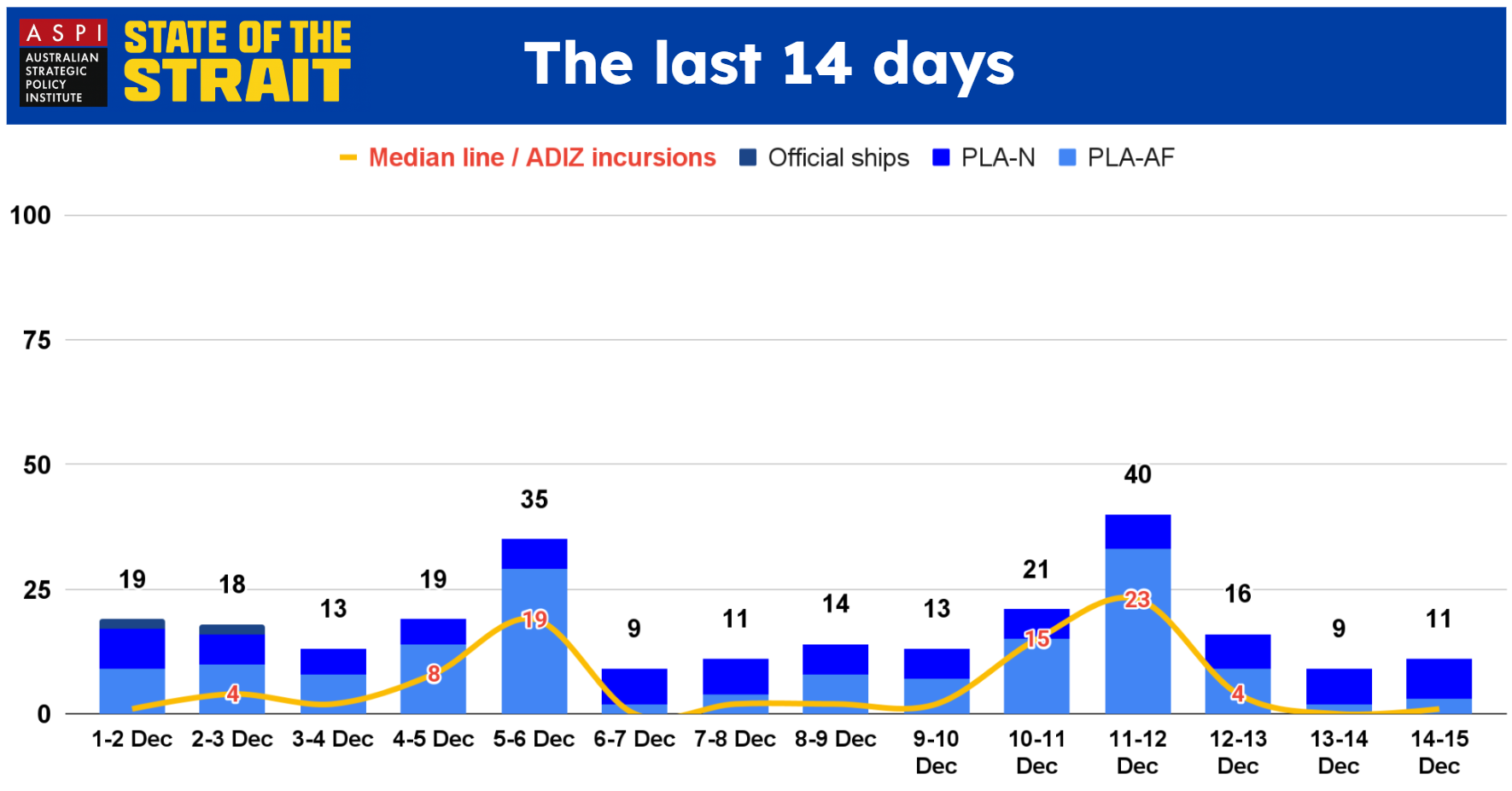
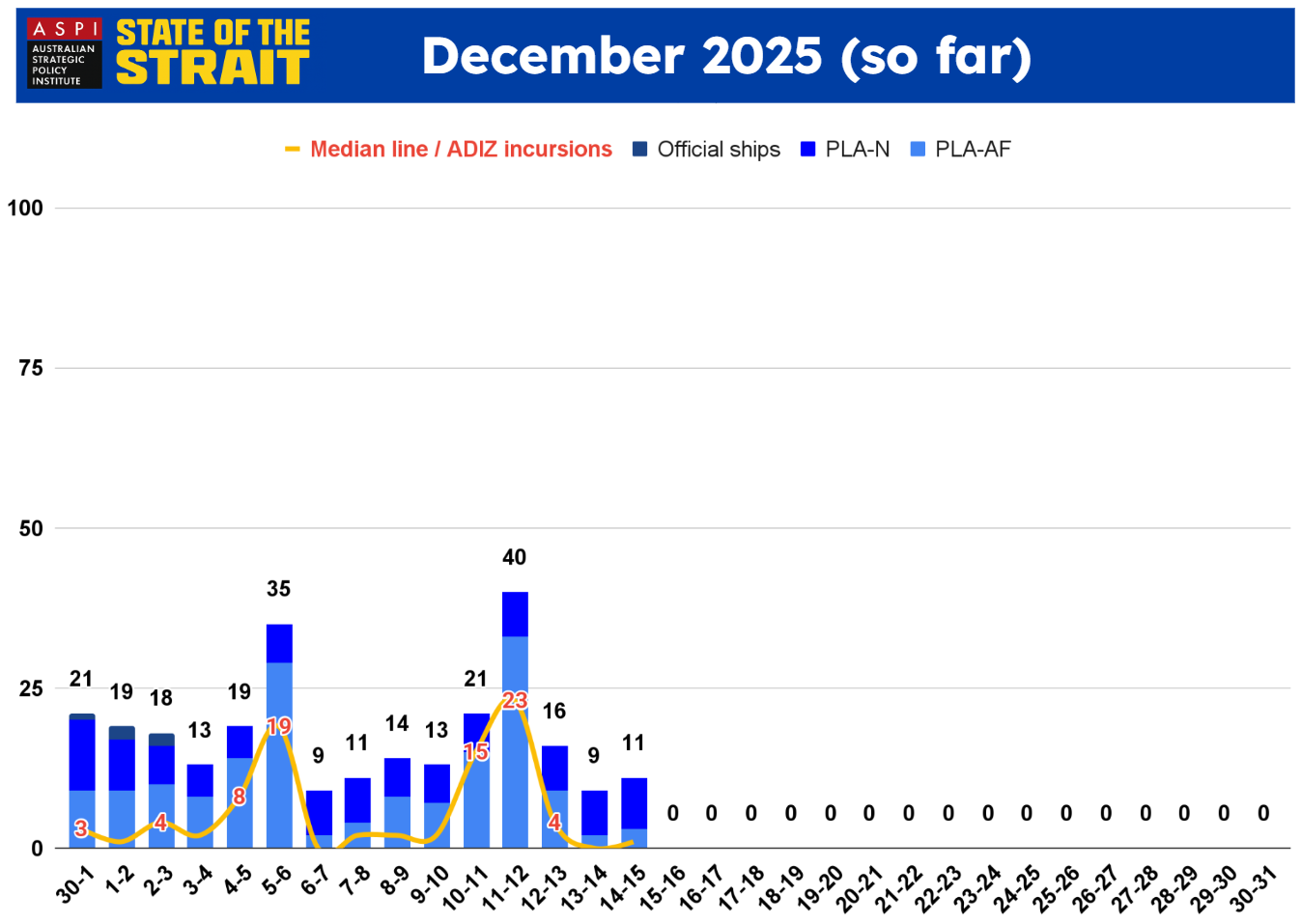
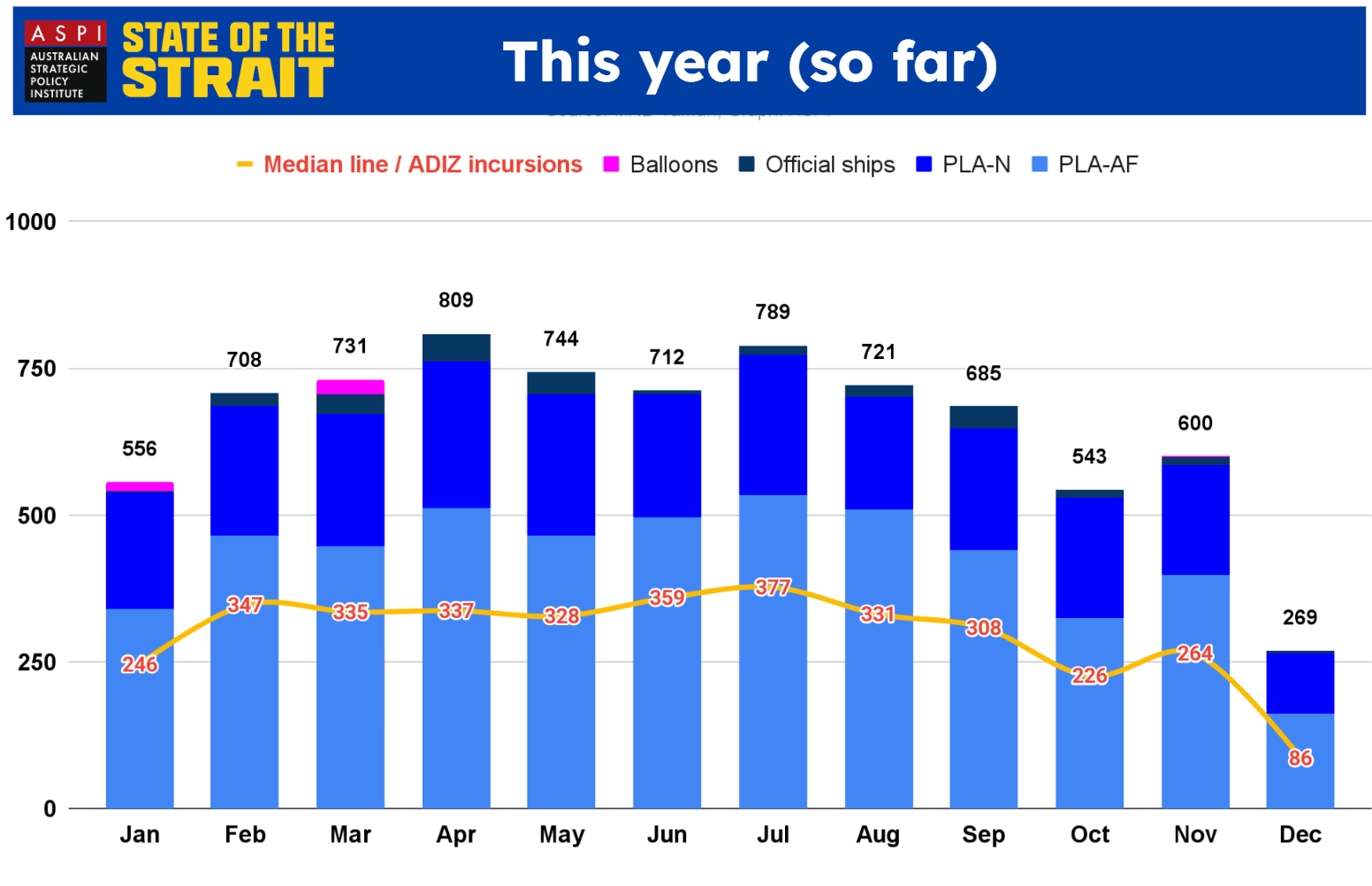
Weekly Charts: PLA activities in the waters and airspace around Taiwan
Source for charts: Taiwan’s ministry of national defense monitors PLA-AF aircraft, PLA-N naval vessels and PRC official ships (e.g. coast guard) and high-altitude balloons operating in the waters and airspace around Taiwan. Numbers are recorded daily for the 24-hour period 0600 to 0600 Taiwan Standard Time (UTC+8).
Sanctioning foreign individuals for engagement with Taiwan
China sanctions former Japanese SDF officer Shigeru Iwasaki over collusion with ‘Taiwan independence’ forces Global Times China announced sanctions on 15 December against Shigeru Iwasaki, former chief of staff of the Self-Defense Forces of Japan, over his public collusion with “Taiwan independence” secessionist forces, which seriously violated the one-China principle and the spirit of the four political documents between China and Japan, seriously interfered with China’s domestic affairs, and seriously infringed on China’s sovereignty and territorial integrity.
United front work targeting Taiwan
ASPI Comment: United front work targeting Taiwan is orchestrated by a network of party-state organisations that aim to influence, cultivate, and co-opt key figures within Taiwanese civil society. The Taiwan Affairs Office in China has described united front work as “an important magic weapon for the Communist Party of China to unite people and gather strength”. The CCP claims the right to speak on Taiwan’s behalf and uses united front work to claim legitimacy for annexation of Taiwan into the People’s Republic of China.
ASPI's State of the Strait tracks events that are facilitated by an agency within the united front and are intended to co-opt, exert malign influence, or redefine Taiwan, its people, and its history solely on CCP's terms.
Taipei mayor Chiang Wan-an to lead delegation to Shanghai for the “Twin City Forum” [台北市市长蒋万安将率团赴上海参加“双城论坛”] Xinhua The Taipei City Government announced on 12 December that Taipei Mayor Chiang Wan-an will lead a delegation to Shanghai from 27 to 28 December to attend the “2025 Shanghai–Taipei City Forum” (commonly known as the “Twin City Forum”), and plans to conduct exchanges and visits on municipal governance. In a press release issued the same day, the Taipei City Government said that the theme of this year’s forum is “Technology Changes Life”. The two sides will deliver keynote speeches and sign memoranda of cooperation
CCP influence in Taiwan’s domestic politics
Reports claim a “Zheng–Xi meeting” around Lunar New Year; Taiwan Affairs Office: ‘Pure fabrication’ [傳鄭習會農曆年前後登場 國台辦:無中生有] Central News Agency In response to media reports claiming that Kuomintang (KMT) chairperson Cheng Li-wun would meet Chinese Communist Party General Secretary Xi Jinping around the Lunar New Year—and that Beijing had set out “three tickets” as preconditions—the Chinese mainland’s Taiwan Affairs Office (TAO) spokesperson Chen Binhua said on 10 December that the reports were entirely fabricated … At today’s regular press conference of the TAO, Chen Binhua said the reports were baseless, accusing the Democratic Progressive Party and certain media outlets of “malicious hype and fabricating rumours”. He claimed their aim was to smear and undermine normal cross-Strait exchanges, suppress political opponents, and reap electoral and political gains.
ASPI Comment: The “three tickets”, reported in Taiwanese media here, refers to preconditions allegedly set by Beijing for a senior KMT–CCP meeting:
Oppose Taiwan’s arms purchases and President Lai Ching-te’s security policy, including blocking the DPP’s defence budget.
Stop or roll back legislation seen as restricting mainland Chinese spouses and cross-Strait exchanges.
Explicitly reaffirm unification with China as the Kuomintang’s long-term political goal.
Beijing has officially denied setting such conditions, but they broadly reflect its long-standing expectations for cross-Strait engagement.
Pressuring others to refer to Taiwan incorrectly as a part of China
Taiwan concerned over Chinese language program materials in U.K. Focus Taiwan The Taipei Representative Office in the U.K. has raised concerns to “relevant institutions” after teaching materials used in the country’s Mandarin Excellence Programme (MEP) reportedly depicted Taiwan as part of China. University College London (UCL), which administers the MEP, said the program has no singular curriculum and that materials in the Mandarin Resources for Schools (MARS) database, which allegedly made the claim, are optional. However, British newspaper The Daily Telegraph said that some teaching materials depicting Taiwan as part of China were produced by UCL’s Institute of Education (IOE).
YouTuber drops sponsorship over Taiwan comment demand Taipei Times A YouTuber yesterday said he decided to back out of a sponsorship deal with a Chinese mobile game company, after it demanded he take down a comment defending Taiwan’s sovereignty. User Davie504, real name Davide Biale from Italy, has 13.6 million followers on YouTube, where he posts content playing bass and guitar. Five years ago, the company “tried to silence me like they were running a covert government operation,” he said in a video posted yesterday.
Disinformation campaigns designed to undermine Taiwan
“Taiwan independence” separatists who forget their roots will inevitably be spurned by the people and judged by history: MOFA [外交部:数典忘祖的“台独”分裂分子必将受到人民的唾弃和历史的审判] Xinhua Foreign Ministry spokesperson Guo Jiakun said on 12 December that Japan once occupied and subjected Taiwan to 50 years of colonial rule, committing crimes “too numerous to record”. He said the Democratic Progressive Party (DPP) authorities not only turn a blind eye to this history but have openly whitewashed Japan’s colonial rule, betrayed the nation, pandered to Japan, and “sold out Taiwan”, willingly acting as accomplices and pawns in the revival of Japanese militarism.
Amplifying criticism of Taiwan or the Lai administration
‘Tramples on democracy’: Beijing slams Taiwan’s year-long Xiaohongshu ban CNA China has hit back at Taiwan’s move to block access to Chinese lifestyle app Xiaohongshu for a year, accusing the island’s government of hurting democracy and depriving Taiwanese of their right to information. The criticism from Beijing comes as the suspension sparks backlash on the self-ruled island, where the Instagram-like platform has more than 3 million users … Many use it to “understand the real situation on the mainland” and interact with mainland Chinese users, he added. “This has made the ‘information cocoon’ created by the Democratic Progressive Party authorities, as well as the slander against the mainland, fail completely,” said Chen.
Chinese mainland urges DPP authorities not to jeopardize Taiwan’s economy CGTN The U.S. Secretary of Commerce announced that the U.S. is aiming to secure over $300 billion in investment and support in training American semiconductor workers in Taiwan, with the goal of moving Taiwan’s entire semiconductor supply chain to the United States. In China’s Taiwan region, netizens criticized the Democratic Progressive Party authorities as “hopeless.” A spokesperson for China’s Taiwan Affairs Office called on Taiwan compatriots to unite, oppose the pro-U.S. actions of Lai Ching-te’s government, and actively defend their own interests.
Taiwan Affairs Office rebuffs Lai authorities’ growth claim: ‘attempting to deceive people by playing number games’ Global Times A spokesperson for the Taiwan Affairs Office of the State Council, said on 10 December that Taiwan regional leader Lai Ching-te is making irresponsible claims and overestimating his abilities, attempting to mislead public opinion and deceive the people by playing number games. Spokesperson Chen Binhua made the remarks in response to Lai’s recent claim in a videoconference interview with The New York Times that Taiwan’s economic growth rate is projected to reach 7.37 percent this year, falsely claiming that he is willing to help the Chinese mainland and “to cooperate in addressing economic challenges” and hoping that the Chinese mainland “will focus not on territorial expansion but on improving the well-being of the Chinese people.”
Cyber attacks on Taiwan’s critical infrastructure
Former digital minister warns TSMC faces rising cybersecurity risks Focus Taiwan Cyberattacks could be the most effective way for hostile actors to damage Taiwan’s semiconductor advantage, former Digital Affairs Minister Huang Yen-nun warned on 10 December, urging companies such as Taiwan Semiconductor Manufacturing Co. (TSMC) to strengthen precautions. TSMC has become “too big to fail,” making it essential to anticipate and manage potential risks, Huang said at an Academia Sinica conference on geopolitics and chip strategy … Huang identified two main types of attackers targeting TSMC. The first are state-backed hackers, many linked to China, including APT41, which seek to steal commercial secrets in chip design and manufacturing.
Outreach to Taiwan’s last 12 diplomatic allies
MOFA blasts China’s Latin America policy paper over Taiwan claim Taiwan News The Ministry of Foreign Affairs on Saturday condemned China’s claim over Taiwan in a policy paper on Latin America and the Caribbean. The foreign ministry said the Chinese report, which claimed Taiwan was an “inalienable part of China’s territory,” was an attempt to distort facts and mislead the international community, according to a MOFA press release … Several of Taiwan’s former Latin American allies have switched diplomatic recognition to China in the past decade, including El Salvador, Panama, the Dominican Republic, Honduras and Nicaragua. However, both of the leading Honduran presidential candidates, Salvador Nasralla and Nasry Asfura, have expressed their intent to resume diplomatic ties with Taiwan if elected.
ASPI Comment: The so-called “ironclad facts” that Foreign Minister Wang Yi claims are “locked in by seven layers” are as follows:
The Cairo Declaration (Dec 1943)
The Potsdam Proclamation (Jul 1945)
Japan’s surrender in 1945 (Aug 1945)
The founding of the PRC (1949)
UN Resolution 2758 (1971)
The China–Japan Joint Communiqué (1972)
The China–Japan Treaty of Peace and Friendship (1978)
Wang Yi’s “seven-layer lock” misrepresents both history and international law. The Cairo Declaration and Potsdam Proclamation were wartime political statements, not binding instruments capable of transferring sovereignty. Japan’s 1945 surrender likewise did not determine Taiwan’s final status; the ROC’s post-war administration occurred under Allied authority, not through a formal cession. The PRC’s establishment in 1949 did not give it sovereignty over Taiwan, which it has never controlled. UN Resolution 2758 settled only the question of China’s representation at the UN and did not address Taiwan’s status, despite Beijing’s claims. Japan’s 1972 communiqué and 1978 treaty with China did not recognise PRC sovereignty over Taiwan; they merely acknowledged China’s position.
No post-war treaty ever transferred Taiwan to the PRC, and the “seven layers” function as a political narrative rather than a legally substantiated chain of sovereignty.
Lithuania refuses to agree to China’s conditions on Taiwan office Taiwan News Lithuania will not meet China’s conditions regarding Taiwan’s representative office in Vilnius, according to President Gitanas Nauseda’s chief foreign policy adviser. Asta Skaisgiryte told Lithuanian radio station Ziniu Radijas that talks with Beijing have seen no “significant progress,” per LRT. She said there is a state of deadlock “because the Chinese side is making a certain demand regarding the Taiwanese office.” She added, “It seems that as long as this demand remains in place, such relations will not be viewed from the Chinese side in the same way as elsewhere.” However, Skaisgiryte did not specify Beijing’s condition.
CCP-aligned groups in Hungary spreading Taiwan-Netherlands disinformation: Dutch experts Radio Taiwan International The Central News Agency (CNA) reported on 9 December that a website controlled by CCP-aligned overseas Chinese community organizations in Hungary recently circulated information claiming that Taiwan’s Military Intelligence Bureau (MIB) has cooperated with relevant Dutch agencies on intelligence gathering. Dutch experts on China say it is a typical united front tactic and a deliberate attempt to warn the Netherlands and other European countries not to cooperate with Taiwan.
China ‘firmly objects’ to Israeli contact with Taiwan after report of deputy FM’s secret visit The Times of Israel The Chinese embassy in Israel says in a statement that it “firmly objects” to any official contact between Israel and Taiwan, following a report today that Taiwan’s deputy foreign minister, Francois Wu, made a secret visit to Israel recently. “The Chinese side firmly objects to any form of official exchanges with the Taiwan authorities, which seriously violate the one-China principle,” says a spokesperson for the embassy, referencing Beijing’s principle that there is only one China and that Taiwan is an inalienable part of China.
Blocking Taiwan’s participation in international groupings
MOFA urges Interpol to include Taiwan Taiwan Today The Ministry of Foreign Affairs criticized the International Criminal Police Organization on 9 December for jeopardizing its cause and mission by excluding Taiwan due to political considerations. The 93rd session of the Interpol General Assembly was held 24-27 November in Marrakech, Morocco, the MOFA said. Its theme of safety through unity was upheld by Taiwan’s allies, namely Belize, Eswatini, Guatemala, Paraguay, St. Kitts and Nevis, St. Lucia, St. Vincent and the Marshall Islands, who demonstrated support in various ways to ensure understanding within international society of the importance of including Taiwan.
WHO responds to agency chief’s alleged pledge to ‘strengthen ties’ with Taiwan South China Morning Post The World Health Organization said on 10 December that its position on Taiwan remained unchanged, after Japan’s finance minister claimed that the health body’s chief executive intended to strengthen ties with the island. On 6 December, Japan’s Minister of Finance Satsuki Katayama stated in a social media post in Japanese that, during a visit to Tokyo, the WHO director general had “explicitly [stated] his intention to strengthen ties” with Taiwan. The post followed a forum in Tokyo on universal health coverage organised by the Japanese government and the WHO. The event was attended by WHO Director General Tedros Adhanom Ghebreyesus.
U.S. report includes Taiwanese activist among political prisoners in China Focus Taiwan The U.S. Congressional-Executive Commission on China (CECC) released its annual report 10 December, documenting individuals detained or indicted by Beijing authorities, including Taiwanese activist Yang Chih-yuan. The report urged members of the U.S. Congress to raise these cases when meeting with Chinese representatives … CECC Chair and Republican Senator Dan Sullivan, along with Co-chair and Republican Representative Chris Smith, said the report ensures that “political prisoners are not forgotten” and that “atrocities are documented.”
Thanks for reading! This post is public so feel free to share it.
















The most comprehesive writeup of this outrage I've read so far - well done!